1 Comment

What Does a “Healthy” Church Look Like?

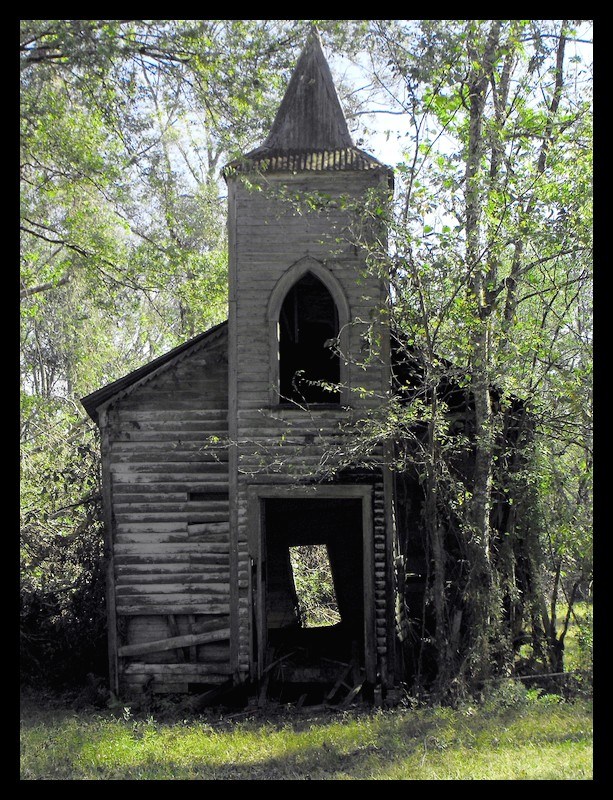
Abandoned, broken down churchMany churches today cannot be considered healthy because they have too many unhealthy members for the church to be considered “well.” Just about any church you go to, there is a mix of healthy and unhealthy members. To what proportion the healthy and unhealthy members exist in a church, to a large extent determines the health of that church as a whole. The ideal, of course, is a church that is heavy on the healthy members, with the unhealthy members getting better, becoming healthy members to contribute to the overall health of the church which leads to a greater effectiveness in not just the continued “healing” of the unhealthy members, but also in what should be the focus of the church: the salvation and integration of new members.

As followers of Christ, church members should be doing all they can to maintain their spiritual health. Unhealthy members should be setting aside those things that have made them ill and be seeking spiritual healing. Unbelievers should find in the church healthy members who can introduce them to Christ and wellness.

In my over half-century of life, I have had the opportunity to either attend or serve dozens of churches and chapels in the United States and in several countries around the world. This has given me a certain amount of insight into the characteristics of healthy and unhealthy churches as I have at times been able to observe from the periphery while other times have experienced it from within. I have discovered many people are confused over what a healthy church looks like…or would rather not deal with their illness, preferring instead to maintain the status quo for some reason. The unfortunate part is, when members choose to remain unhealthy, their lack of health can infect other members whose immune system may still be weak, or else they pull down new members who have not yet achieved a mature health, contributing to the decline in the overall health of the church instead of the ideal growing health.

While no list can be all-inclusive, I offer these ten characteristics of a healthy church from what I have learned and observed over the years, with the prayer that the healthy members will grow healthier and the unhealthy will find new health.

1.  In a healthy church, members enjoy coming together to worship. I remember one Sunday when I was a child of about 11 or 12 coming out after church and telling my dad that I really enjoy going to church. There was something about that church of my youth that drew me in and satisfied me. With me not knowing what I needed, the church met my needs and gave me a sense of satisfaction. In a healthy church, people want to be there. People want to be a part of the Body of Christ that is the church. Whenever the doors of the church are open for services (or service), the healthy members are there because they want to be. There are times when either sickness or obligations keep members away, but healthy members guard against those times so they are few and far between. Unhealthy members, on the other hand, look for reasons to not be there instead of clearing the way to ensure they are.

2. A healthy church is not necessarily large. Many small churches are healthier than larger ones. It is not the size that makes the church healthy, but a preponderance of healthy members, and they doing things in a healthy way. I recall a church I attended that seemed to continually get more healthy as a whole as it shrunk in size. The decrease was caused by unhealthy members leaving (not willing to move on to health) which enabled those who remained to grow more healthy. Eventually, that church likely would have also grown in size since a healthy church is introducing new people to Christ, though again, large does not always equal healthy.

3. In a healthy church, conflict is dealt with biblically, which is probably why members enjoy coming together to worship! In a healthy church, when someone is offended, they follow the biblical instructions and properly deal with the offense. When someone sins, the church follows the biblical instructions to help that person be restored. When there are attitudes or actions for which the Bible requires discipline, it is done Scripturally and in love. When there are disagreements, they are discussed and there is reconciliation even if not agreement. The problem with unhealthy churches and, in fact, the modern church as a whole, is that it is easier to just go to the church down the road or across town instead of dealing with problems or issues that arise where you are. In the same way, church discipline is less effective since there’s nothing to keep the offending member part of the church. But a healthy church is able to deal with whatever problems arise in a biblical, loving and healthy way so that reconciliation takes place and the family, the Body of Christ, is restored. When conflict comes (and because the church is made up of humans, conflict will come), the healthy members run toward each other while the unhealthy members run away.

4. In a healthy church, members come to give instead of to receive. Healthy church members have discovered that their relationship with Christ means that they have become servants. They serve. They give. When it comes to worship services, the healthy come to offer worship not to receive a blessing. The healthy members do not judge the “success” of a service by what they got out of it but rather by what they put into it. However, unhealthy members come to a service for what they can get out of it, to have their needs met. You often hear them say, “I just don’t get fed there!” The ironic thing about it is that those who come to get seldom are satisfied while those who come to give receive more than they ever expected!

5. In a healthy church, the pastor and his family feel loved & blessed and are sufficiently cared for. Healthy church members realize the role of the pastor is a difficult one and understand the Scripture mandate to care well for him and his family. Healthy members are an encouragement to the pastor, even when they may have disagreements. Healthy churches are generous with their pastor and family on birthdays, anniversaries and holidays. Healthy members accept the role of the pastor in the church and give him freedom to minister as God leads; and if they do have a difference with the pastor they go to him instead of others to discuss it. Unhealthy members often try to squeeze the pastor into their mold instead of allowing him to be faithful to God and his calling. Unhealthy members try to manipulate the pastor instead of blessing him. Unhealthy members resent the use of church funds to provide a reasonable subsistence, not to mention “extras” for the pastor and family. When an unhealthy member has a problem with the pastor (often as a result of a misunderstanding or difference of opinion) unhealthy members talk to others about it instead of going to the pastor as Scripture instructs.

6. In a healthy  church, members serve in areas where they are gifted and are satisfied with their service. I have always been of the opinion (and probably read it somewhere) that a church should only do those ministries that it has healthy members gifted in those areas to do. I firmly believe that God “gifts” a church to do the ministries that He wants it to do. When the church tries to fill positions with any warm body regardless of their gifting, not only does the ministry suffer but also the people who are squeezed into the wrong positions. The healthy members will have a sense of their gifts and will serve in those areas where they then receive confirmation from the church and satisfaction from their service. However, even if a member has been gifted in a particular ministry, if they are not healthy, they are unlikely to be satisfied. Because of their unhealthiness, they won’t put sufficient effort into preparation or presentation and it will become a drudgery for them, not to mention to those to whom they are trying to minister.

7. In a healthy church, finances aren’t an issue. There are a number of reasons for this. First, money just isn’t the focus in a healthy church; seeking God and doing his will is. Second (and likely a cause for the first), healthy members give generously (and cheerfully) so there is always enough. Third, since a healthy church only does the ministries that God has gifted that church to do, there is plenty of money to go around. It is the unhealthy members who make money an issue. They sometimes feel they need to control where every dollar goes to make sure nobody is getting an advantage; or else they feel like since they have given some of the money, they should have a say where it goes, complaining if funds go toward a project they don’t agree with. The funny thing is, often the people who are most controlling over how a church’s money is spent are the ones who give the least, or the least cheerfully.

8. In a healthy church, gossip, division, dissension and discord do not take root. Healthy members shut down gossip from unhealthy members before it begins. Instead of sowing discord and dissension, healthy members strive for unity. Unhealthy members, on the other hand, seem to thrive on gossip. It’s like they have to make sure everyone knows what someone did wrong or even what someone may have done wrong. Unhealthy members get together with other unhealthy members to form sides to get their way. Extremely unhealthy members even continue to influence other unhealthy members after they have failed to biblically deal with disagreements or offenses and instead have left the church.

9. In a healthy church, there aren’t hostages. Unhealthy churches, or unhealthy members, will “hold hostage” their tithe & offerings, their attendance, or even their membership to get what they want. If they don’t like what the church is doing with their money, unhealthy members will withhold their tithes and offerings. If an unhealthy member doesn’t like how a particular ministry is being run (or the person who is running it), they’ll withhold their attendance. If an unhealthy member doesn’t like something the pastor does, they’ll withhold their membership and maybe attend the church across town. The healthy member, on the other hand, remembers that it’s all about giving and not receiving, so they don’t have to approve of how the church spends its money, or how a ministry is run, or what the pastor does. The healthy members are there to give, to serve, to bless others, not for what they can get or to have their way.

10. A healthy church realizes that sometimes unhealthy members will never become healthy. This is a sad acknowledgement, but sometimes unhealthy members are so ravaged with their spiritual illness that there is little hope of recovery. Grant it, God can do more than we can ask or imagine, but the unhealthy  have to want to become healthy for God to bring healing to their lives. Many times they have their own will so ingrained within them that they have long since mistaken it for God’s will and won’t see things any other way. It is at this point that the healthy church needs to be willing to let go of unhealthy members for the sake of the church’s survival. To continue to enable unhealthy members to bask in disease or allow them to hold the church hostage to get their own way is to prevent the church from truly becoming healthy.

There is, what a former District Superintendent of mine called, blessed subtraction. When an unhealthy member refuses new health, discipline and/or reconciliation in favor of remaining unhealthy or getting their way, it can be a blessing for the church to let them go (or even to ask them to leave). When the doctor discovers cancer in a human body, he first tries to heal that part of the body. If the cancer hangs on, if healing isn’t possible, the doctor cuts it out, completely removes it, eradicates it in order to save the life and restore the health of the rest of the body. Sometimes, this type of radical surgery is necessary to save the life and restore the health of a church.

.

.

.

Leave a comment

Love, Terrorism and Immigration

Immigration

I’m not making a political statement, but I’ve been wondering how it became an injustice to not extend a privilege. Entry into any country other than your own is a privilege not a right. I remember traveling to many countries and actually wondering if I’d get in or be turned away. Not one of those times did I ever think that if I was refused entry that I would try to demand my rights. I had no rights in regard to entering a country of which I wasn’t a citizen. I wouldn’t have felt persecuted, mistreated or as though I didn’t receive justice.

It seems that we should think similarly about people seeking to enter the United States. As a Christian I want to be welcoming to anyone seeking to enjoy the freedoms I enjoy, but even that desire doesn’t make not granting the privilege of coming to the U.S. an injustice. So why are people so upset that some people won’t be granted the privilege to enter the U.S. for a while? Because of the countries they come from which are known to produce terrorists? Because some countries that also produce terrorists were excluded from the list? Because those countries are Muslim countries? Because there’s no proof that terrorists are trying to infiltrate the U.S. through “legal” immigration? Because history (so far) hasn’t proven this is a terrorist technique?

But does any of that really matter?

In the military we understand the idea of a preemptive action to avoid a greater military engagement. There is an element of Just War Doctrine that allows for a preemptive strike if there is evidence of an impending attack. I haven’t been invited to any of the President’s briefings and haven’t been privy to the counsel he is given, but couldn’t it be that this is what we’re seeing? We’ve been engaged in a “War on Terror” for over a decade now. We have seen combat against terrorism take place in many parts of the world just as we have seen terrorist attacks in many peaceful countries. We have seen reports that “ISIS … has specifically and publicly called for the infiltration of the refugee program – seeking to use refugees fleeing genocide as camouflage to enter the United States and inflict terror…[and] has successfully inflicted carnage in this way throughout Europe.”Should we wait for another attack before we respond? Should we wait and see how many terrorists slip in through our current immigration or refugee process? Or should we try to peacefully preempt terrorist attacks on our soil by limiting the entry of people from known terrorist-producing countries, at least until a better vetting process is in place?

Yes, as a Christian I am obliged to welcome and care for the stranger, which includes immigrants and refugees, and I want to believe that if I come into contact with any that I will be kind and compassionate, and help them in any way that I can. But does that Christian obligation extend to my insisting that my country accept any possible risk, potentially forsaking its responsibility to protect its citizenry, and provide easy access into our borders?

immigration-againstIt occurred to me, at least from my unscientific observation of Facebook friends and others in the media, that most of those who are crying “injustice!” about President Trump’s recent executive actions are the same ones who oppose war and violence in any of its forms and decry the U.S.’s military actions to fight terrorism. Many of these same people are also among the first to cry “injustice!” when seemingly excessive force is used against perpetrators of crime and even terror on our own soil. Admittedly, most of us would want to avoid war and violence if we could, even as we seek to eliminate terrorism. Most of us would like to see the enforcement of peace and order in our own communities without as much violence and killing. So it seems like a peaceful deterrent to possible terrorism, like slowing the entry of immigrants and refugees who may hold ill-will against the U.S., would be more desirable even if it makes it more difficult for us to extend to them Christian charity.

Much of the chanting I’m hearing about the new (likely temporary) policies on immigrant and refugee acceptance into the U.S. seems to revolve around our Christian obligation to welcome the stranger and provide for them. This is valid and commendable but it isn’t as though the only way to care for them is if we allow them into the U.S. Yes, some may be safer here than in their own, or other, countries but this still needs to be weighed against the safety of the citizens of the U.S., with the ability of the U.S., NATO and U.N. to provide safe zones for refugees from war-torn countries nearer to their homes. Christians can still give, and even go, to take care of those in need around the world. Limiting immigration to the U.S. doesn’t prevent a Christian response.

immigration-helpI realize that the situation is much more complicated than what a blog post can answer and there are many more facets to the immigration and refugee policies put in place by both the current and past presidents than can be discussed here, but what I’ve been trying to show, at least in part, is that there is more than one way to view immigration and refugee policy, foreign policy, military policy and even Christian social action.

While we can petition and protest, significant change to current policy (under whatever president we may find ourselves) isn’t likely so why not concentrate our efforts on actually helping the situation by doing what we can to help those seeking safety, assistance and freedom, within the system that exists? If we can’t welcome them into our country, love them where they are by giving and sending aid or even going and serving them where they are. If we can’t change how our government accepts or rejects those seeking entry into our country, work within the system to help those in need to legally gain entry. Sure, it’s not as easy and doesn’t offer as many photo ops, but at least something is being accomplished other than flooding the news feeds of social media with statements of protest and condemning memes.

On second thought, maybe I am making a political statement.

.

.

.

I just want to add that I’m not your average armchair commentator. I’ve been to over two dozen countries, several of them Muslim. I’ve lived in three countries other than the U.S. and have deployed to two others. I’ve had friends and many conversations with Muslims and Muslim converts to Christianity and have been involved in helping some of them both in their country and to come to the U.S. I’ve led teams to Afghan villages and the Egyptian and Korean hospitals in Bagram to provide humanitarian assistance to Afghans in need; and I have raised funds and supplies for distribution. By sharing a little of my experience, I’m not seeking a pat on the back, but rather a bit of your time to hear what I have to say.

.

.

1American Center for Law and Justice, “What President Trump’s Executive Order on Immigration and Refugees Does and Does Not Do.” Accessed from their website 31 January 2017.

Photo credits: Pro-immigration protest from the Boston Globe website; “Close Borders” protest from News Radio 710 website. Distributing donations from the Glasgow Evening Times website.

.

.

Leave a comment

Abortion: Is it the worse sin?

With all the talk about abortion resurfacing in the media, it’s good for us to remember this…

Daryl Densford's avatarHere I Sit

Human embryo at 6 weeks

Abortion is sin.  There is no doubt about it.  Just a few days after conception, the baby’s heart is pumping blood through its body. You can see fingers and toes forming, you can hear the heart beat.  Yet, these babies are considered just a “mass of flesh” by the abortionists.

“Scripture seems to teach that the unborn fetus is an individual person.  Isaiah says, ‘The Lord called me from the womb’ (49:1, RSV).  Paul says that God ‘set me apart before I was born, and had called me through his grace’ (Gal. 1:15, RSV).  John the Baptist was ‘filled with the Holy Spirit, even from his mother’s womb’ (Luke 1:15, RSV). And a psalm writer called himself a ‘me’, a self, when he wrote that ‘in sin did my mother conceive me’ (Ps. 51:5, RSV).  Also, in Ps. 139:13 we read, ‘Thou didst knit…

View original post 1,040 more words

Leave a comment

Pearl Harbor 75th Anniversary Commemoration

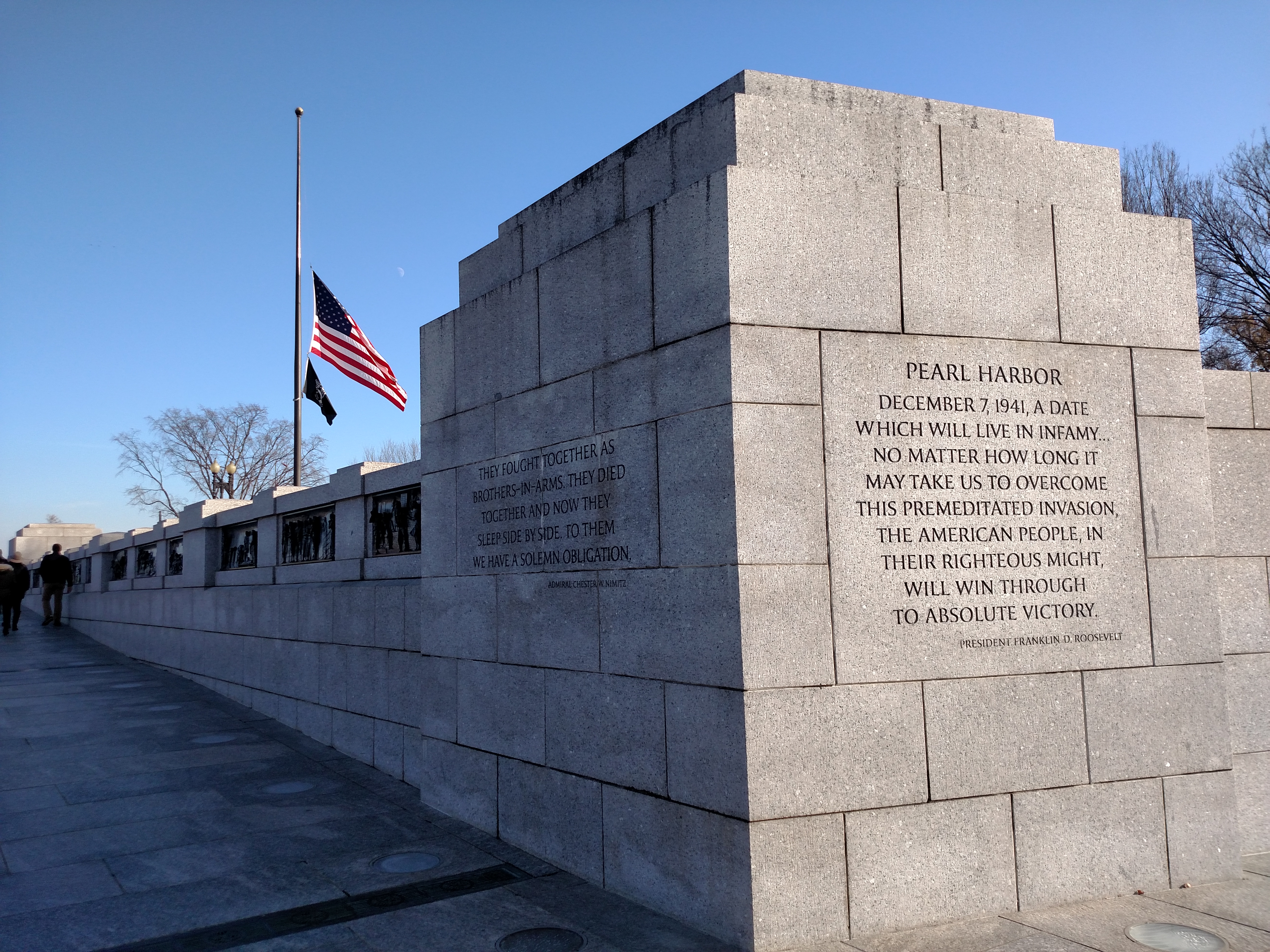
With 2016 being the 75th anniversary of the Pearl Harbor attack and the United States’ official entry into World War Two, the various commemorations around the country are even more significant. I had the priviledge of attending the Pearl Harbor 75th Anniversary Commemoration  at the National World War 2 Memorial in Washington D.C. Present were seven Pearl Harbor survivors along with many more WW2 veterans. The keynote speaker was Senator John McCain, whose father and grandfather both served during WW2. The Invocation was given by Rev. Richard Young who is a Pearl Harbor survivor who became a minister after his military service. Navy Chaplain, Commander Michael Pumphrey, CHC, prayed the closing prayer with significant emphasis added through the accompaniment of the U.S. Navy Ceremonial Band. Vice President-elect Mike Pence was also there, though wasn’t on the program.

Here are a few pictures from the ceremony, with videos of Rev. Young’s and Chaplain Pumphrey’s prayers:

Pearl Harbor 75th Anniversary Commemoration


Mike Hydeck

The Master of Ceremonies was Mike Hydeck, WUSA9 CBS Morning Anchor.

Pearl Harbor 75th Anniversary Commemoration

At the podium is Gay Vietzke, NPS Superintendent of the National Mall and Memorial Parks. Seated to the left is Senator McCain, Vice President-elect Mike Pence and Frederick Smith, founder and president of FedEx.

Elliott (Toby) Roosevelt III

FDR’s great grandson, Elliott (Toby) Roosevelt III, read FDR’s statement to Congress on the day after the Pearl Harbor attack, and Eleanor Roosevelt’s message to the nation on the evening of the attack.

Senator John McCain

Senator John McCain was the Keynote speaker. Not only is McCain a Vietnam veteran and POW survivor but his father and grandfather both served during WW2 and both became flag officers.

Pearl Harbor 75th Anniversary Commemoration

On the other side of the fountain, the dignitaries and veterans in attendance place wreaths at the Freedom Wall.


.

Here are a few pictures of some of the people I met at the ceremony:

Pearl Harbor 75th Anniversary Commemoration

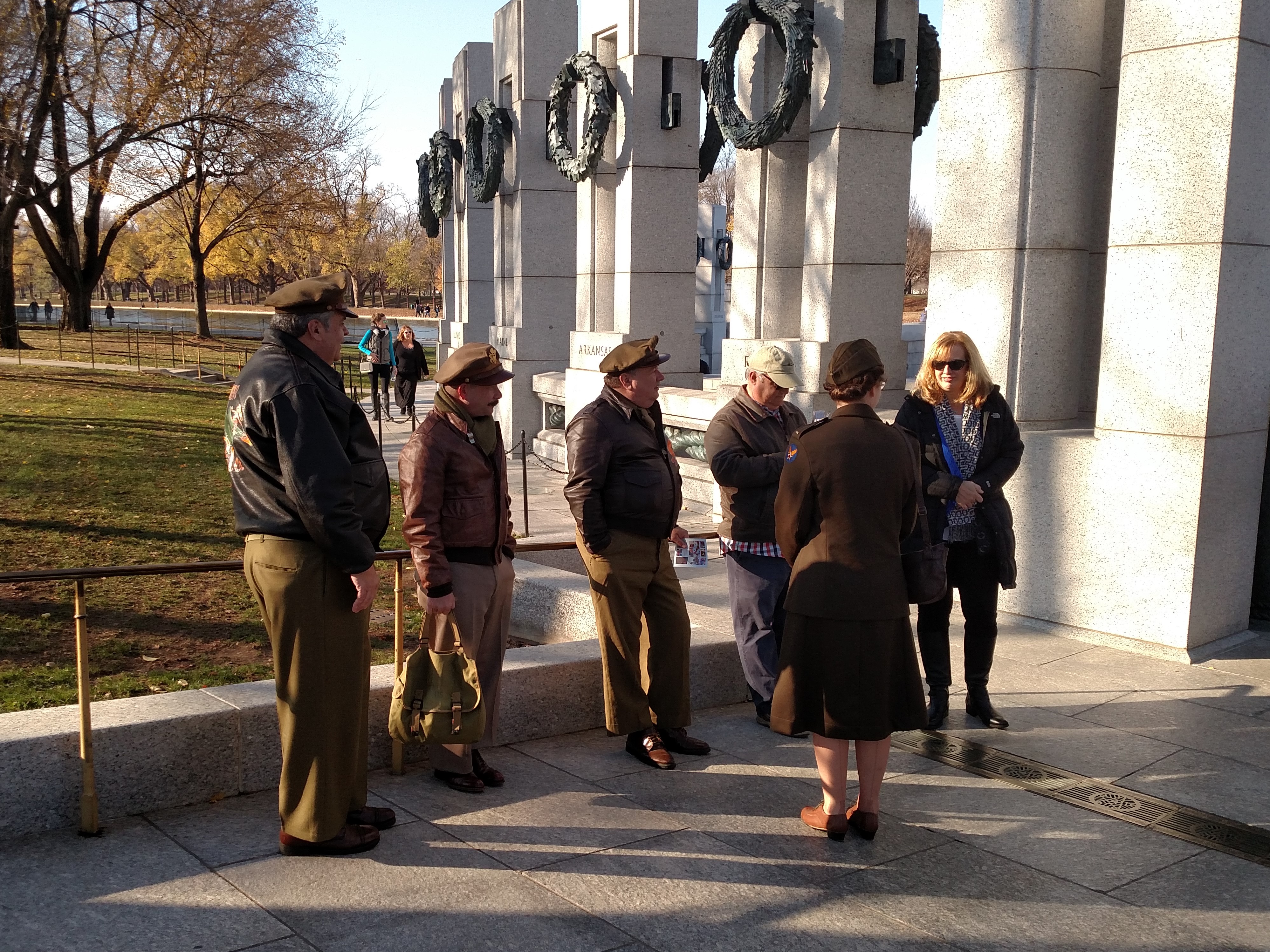
Dressed in period uniforms, volunteers of the Living History program at the WW2 Memorial escorted the WW2 veterans into the ceremony.

Mike Hydeck

Me with Mike Hydeck, WUSA9 CBS Morning Anchor, who was the Master of Ceremonies. (Look at his white teeth. He evidently doesn’t drink the amount of coffee and Coke that I do!)

Rev. Richard Young

Me with Rev. Richard Young, Pearl Harbor Survivor who became a minister after the war. Rev. Young provided the Invocation for the ceremony.

Lieutenant General Julius Wesley Becton Jr.

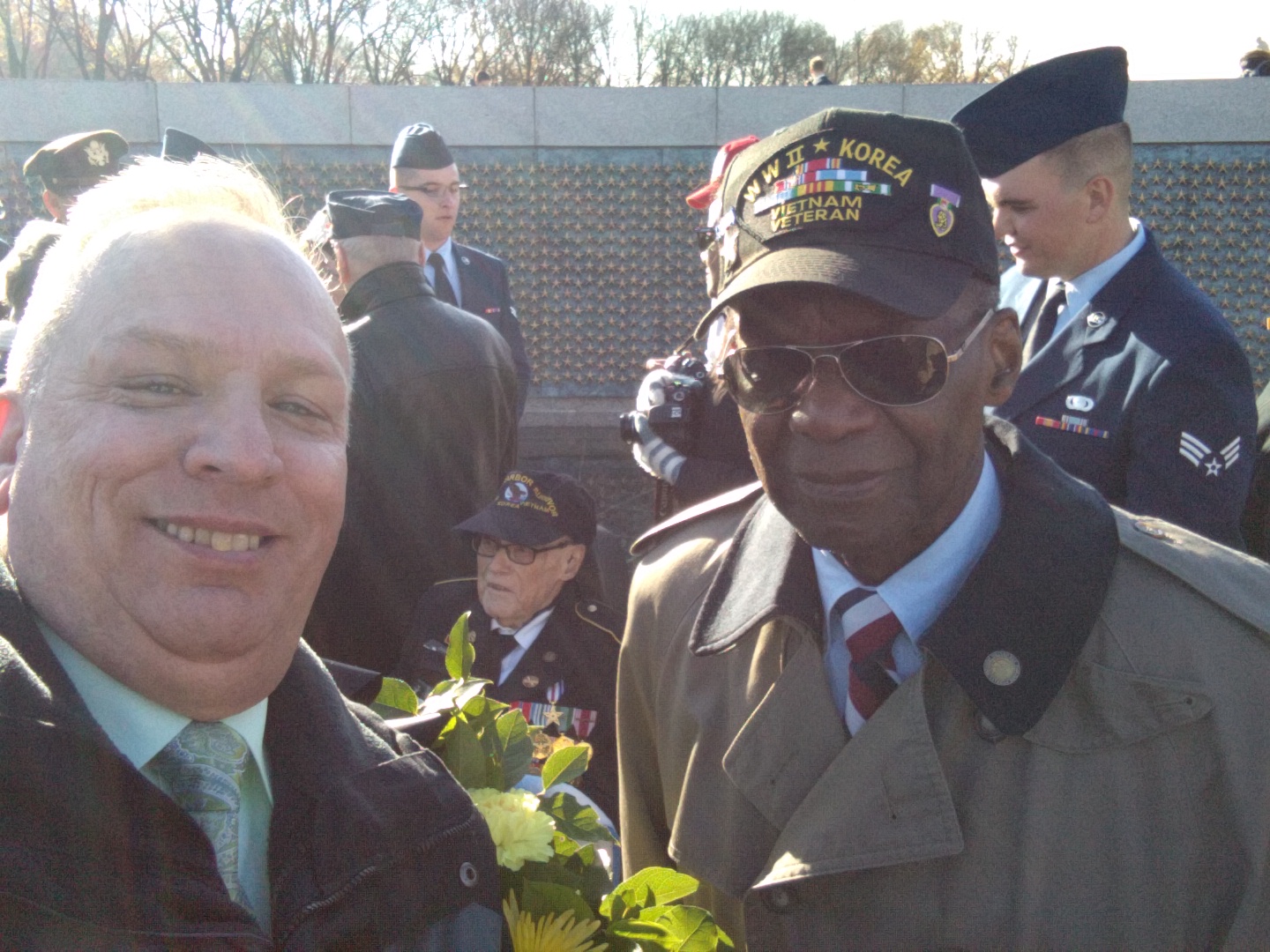
Me with Lieutenant General Julius Wesley Becton Jr. (Ret.), a veteran of WW2, Korea and Vietnam.

Chaplain Michael Pumphrey

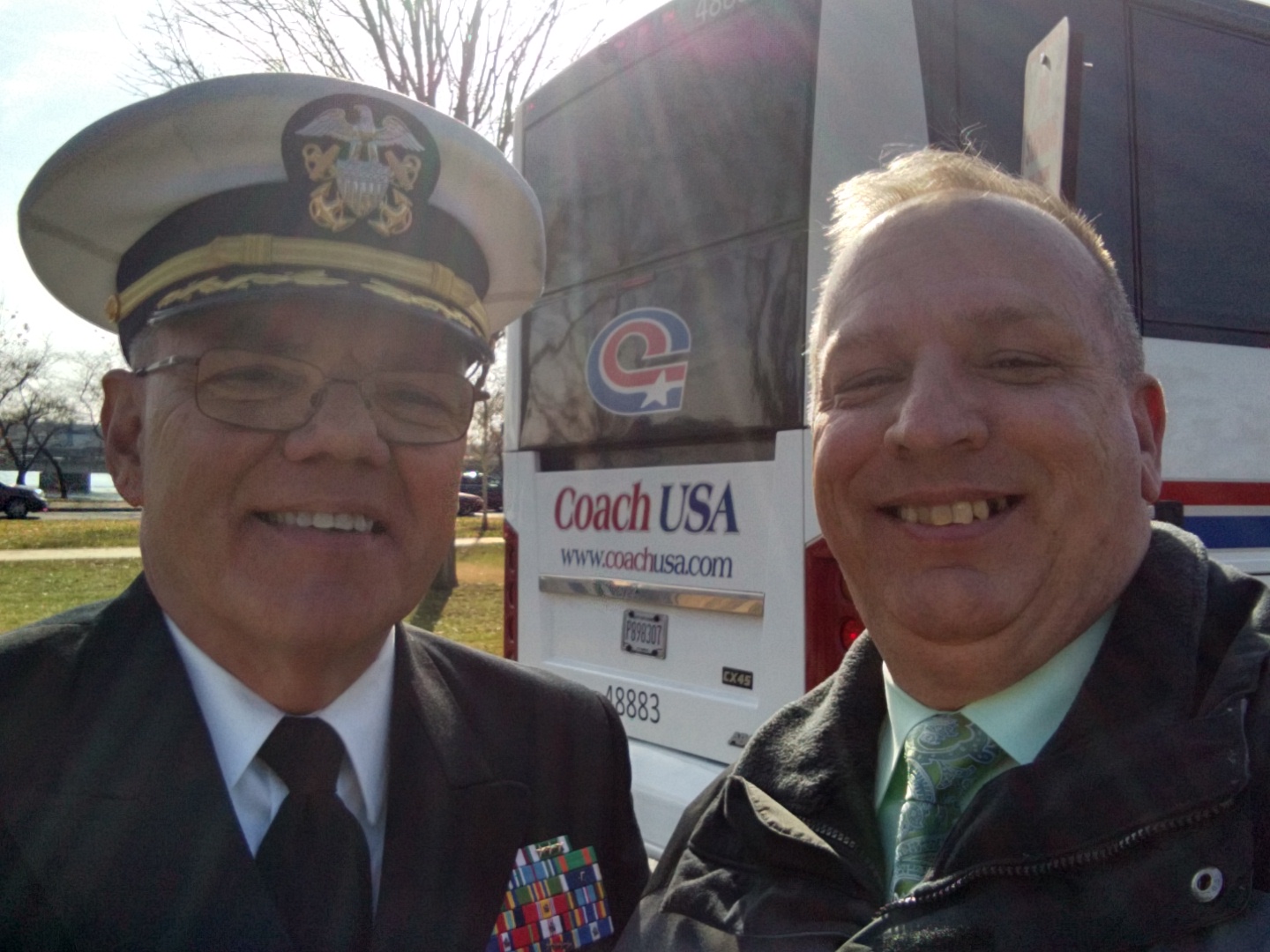
Me with Navy Chaplain Pumphrey who prayed the closing prayer at the ceremony.

Chaplain (COL) Austin

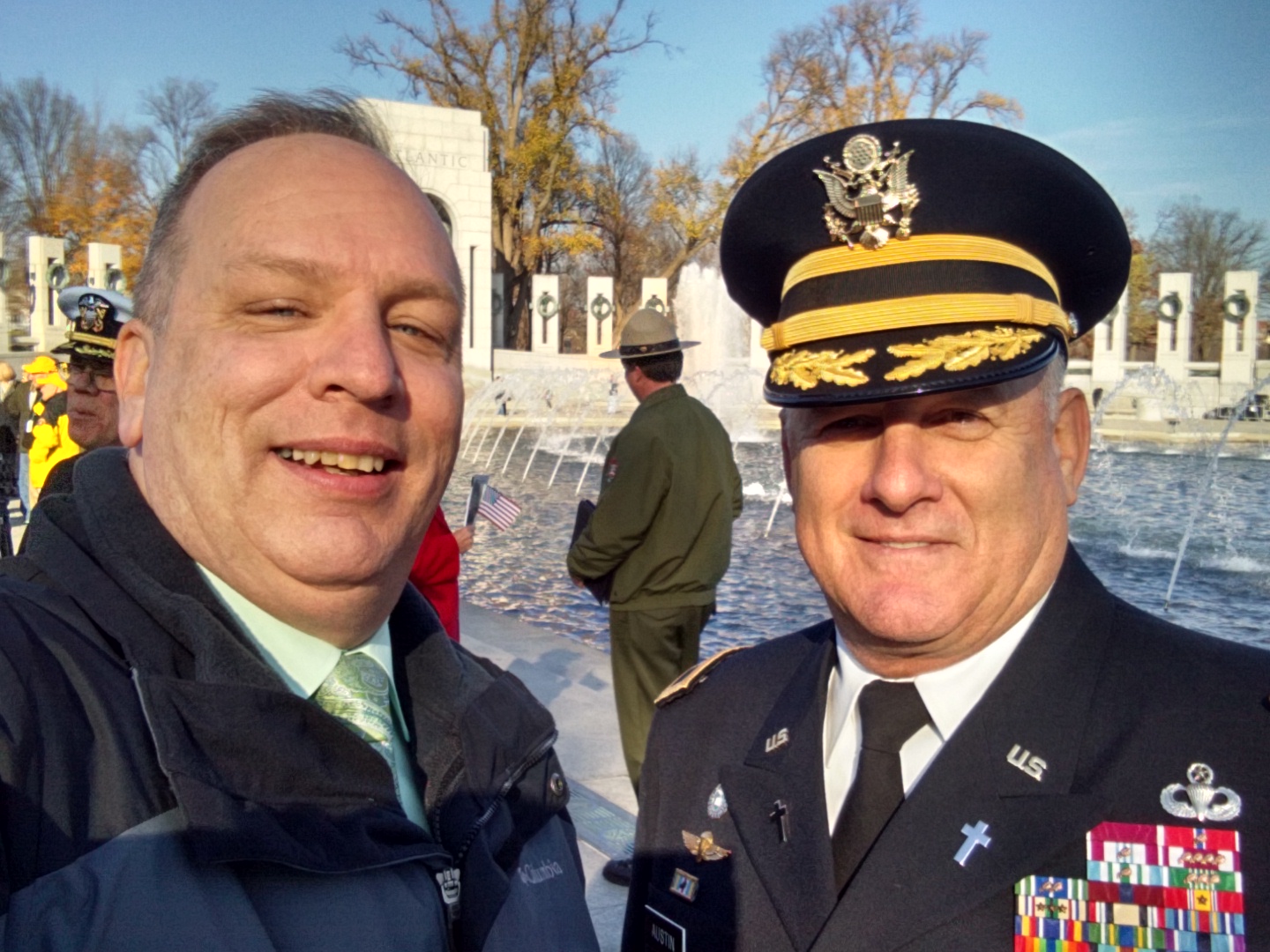
Me with Army Chaplain (COL) Austin, who wasn’t on the program but was in attendance at the ceremony.

WW2 Memorial

.

I’ve really enjoyed being near Washington D.C. for a few months since in addition to all that I’ve been able to see, I’ve been able to attend events like this.


.

.

.

Leave a comment

Pearl Harbor Candlelight Vigil and Reading of the Names

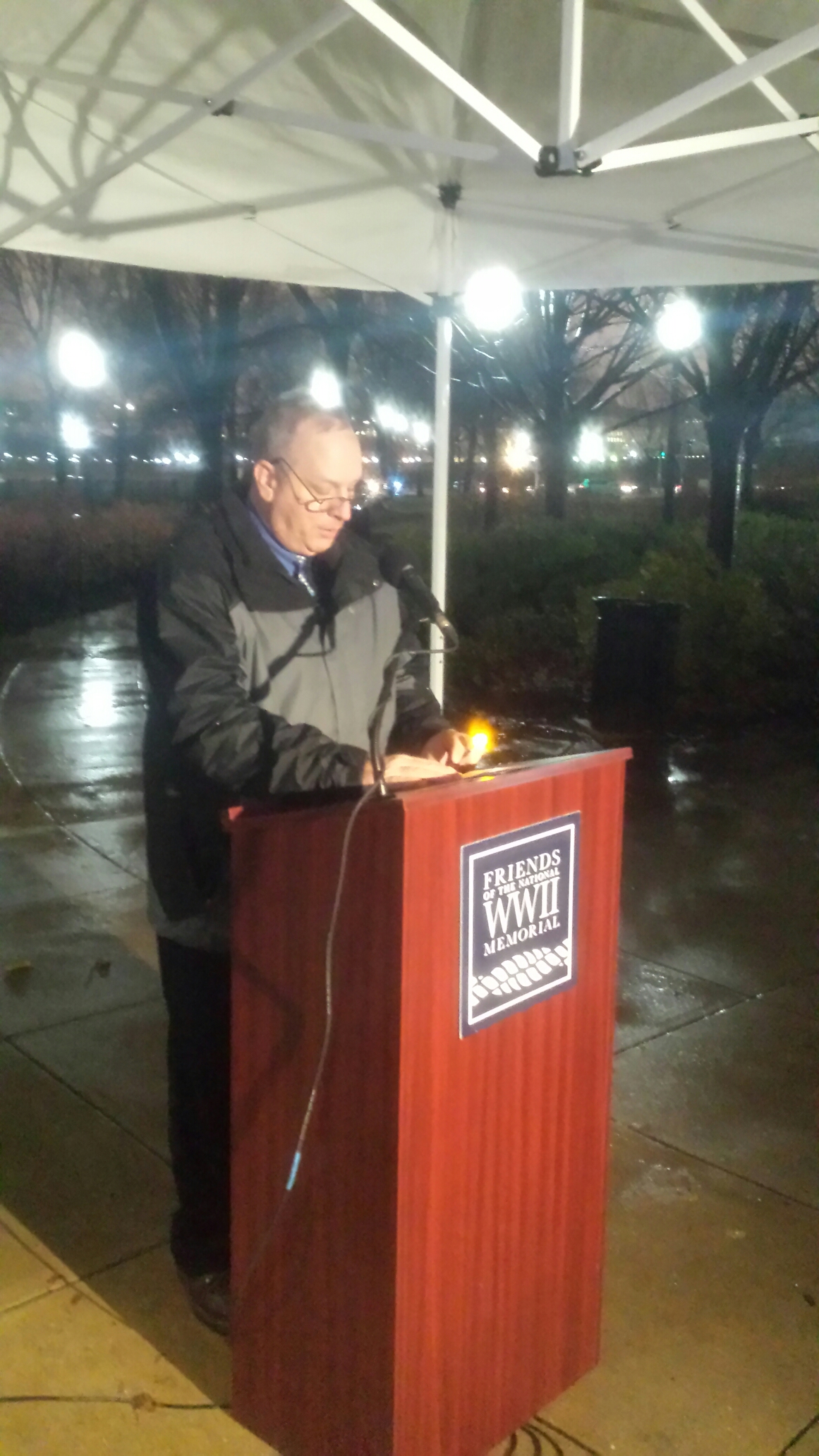
On December 6th, 2016 I had the honor of participating in the Pearl Harbor 75th Anniversary Candlelight Vigil and Reading of the Names at the National WWII memorial in Washington D.C. I was one of many people, young and old, who withstood the cold and rain to honor the 2,403 Americans who were killed during the Japanese attack on Pearl Harbor 75 years ago.

While the weather moved the vigil from the center of the WWII Memorial to beside the nearby Ranger Information building, the significance of the event remained the same as every name of the victims was read, of which I read 90. I think the weather also limited the attendance but it remained a tremendous honor to be able to participate and honor the Service Members and civilians who died on that infamous day.

Rev. Richard Young

Pearl Harbor survivor, Richard Young, who after his military service became a minister, prayed the Invocation.

Chaplain Daryl Densford

Me reading some of the names.

Pearl Harbor Vigil

Some of the younger participants included Airmen from Fort Meade.

Harry Miller

Harry Miller was one of the WW2 veterans I met. He was a Crew Chief in the 740th Tank Battalion during the war.

Pearl Harbor Vigil

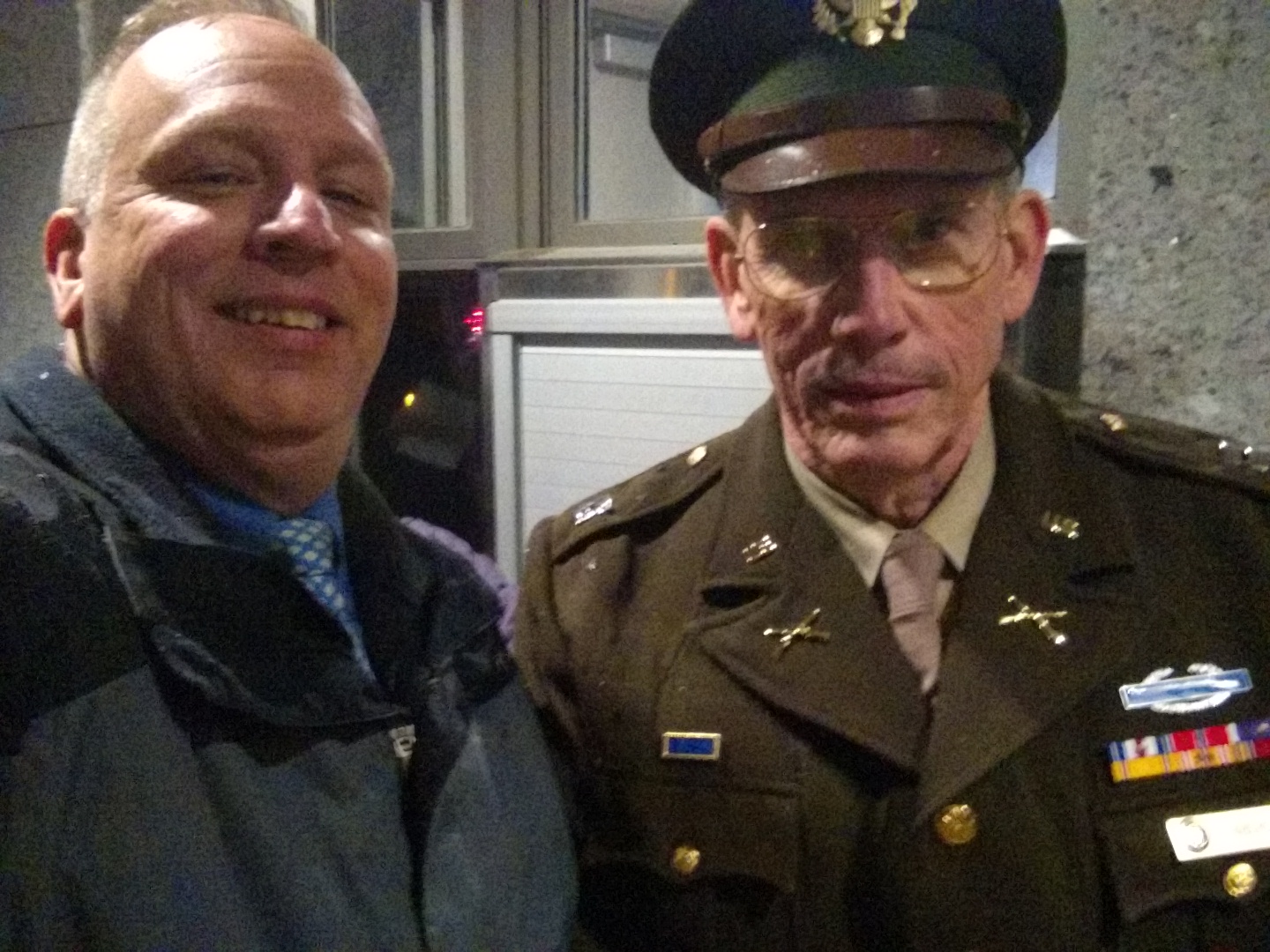
This man isn’t a WW2 veteran but his father served for 41 years! He is part of the Living History program at the WW2 Memorial, thus his WW2-era uniform.


This video was a live feed by Fox 5, a local Washington D.C. T.V. station, which began airing with me reading names.

.

.

Leave a comment

Thanksgiving in Afghanistan

As this Thanksgiving day draws to a close in the United States, I am reminded about the nearly 200,000 Service members who are deployed in support of Combatant Commands this Thanksgiving. It’s never easy being away from home and family, but it is especially hard during holidays. The United States does their best to help those separated from family by bringing them a taste from home. According to U.S. Central Command, the Defense Logistics Agency provided to troops deployed to Afghanistan, Iraq, Jordan and Kuwait:1

  • 34,760 pounds of turkey
  • 32,550 pounds of beef
  • 21,450 pounds of ham
  • 28,980 pounds of shrimp
  • 9,114 pounds of stuffing mix
  • 879 gallons of eggnog

thanksgiving-afghanistanSome of these Thanksgiving meals are served in hardened dining facilities while others are in tents. Many Soldiers get a plate to eat while on guard duty, or in the motor pool working on vehicles that need to be repaired before the next mission outside the wire. I remember being the beneficiary of at least a few pounds of these goodies during my deployments to Iraq and Afghanistan as I joined the tens of thousands of other Soldiers, Sailors, Marines and Airman whose commitment to their country and willingness to serve took them away from their families in order to defend our freedom and the freedom of others.

Looking back to 2006, I sent monthly prayer newsletters to family and friends who supported me in prayer and encouragement during my deployment. Here is what I wrote to them following my Thanksgiving in Afghanistan which may give you an idea of what some of our military members may be feeling today:

You know for sure that you’re away from home when holidays come along. Thanksgiving was the first real holiday that I experienced away from my family on this deployment. For as long as I can remember Thanksgiving was a time when my extended family got together at my grandmother’s for an unbelievable feast. It also included many traditions that to this day Thanksgiving doesn’t seem like Thanksgiving without. I missed getting up early on Thanksgiving morning to help grandma stuff the turkey. I missed squeezing around the table in the dining room as the family grew each year. I missed the walk with the “men” to Pop Wiley’s after dinner. Mostly, though, I missed Holly and all my children-even the newest one that I haven’t even met yet, realizing that they are my greatest reason to be thankful these days. I can’t imagine life without them and feel like my life is just partially complete over here on the other side of the world. As I sat in the dining facility in Kandahar, Afghanistan eating my turkey, I had to fight back the tears as I thought about my family and how far away I was from them. For me, Thanksgiving will really be when I get home to m y family!

Getting back to Afghanistan: Kandahar is a place that is getting less and less American. As you probably know from the news, NATO has taken over responsibility for the area so we Americans are in the minority. I really feel even more away from home there as I look around and nearly all I see are foreign forces including the British, Canadians, Dutch, French and several other smaller elements. In comparison, there are just a handful of Americans so everyone else probably watched with amusement as we celebrated a day that is so big to us in the U.S. The dining facility went all out with decorations. The picture above was just inside the entrance to the serving line, the door of which was surrounded by a massive tee-pee on the outside. All through the dining facility were decorations depicting our first Thanksgiving including a massive ice sculpture! Then there was the meal-they pulled out all the stops to help make us Americans feel at home. There was the traditional turkey (cut from the bird & put on our plate), turkey breast, ham, yams, stuffing, and all the other “fixin’s” (except I missed mom’s cranberry salad!). Then the deserts  went on and on: Pumpkin pie, pecan pie, apple pie, etc., etc.! It was great. I’m sure that it helped our Soldiers feel a little more at home as the dining facility workers brought a bit of home to them!

I hope that you and your families had a great Thanksgiving where you are and that you remembered to thank God for our American Soldiers who are away from home defending our freedom.2

Again today, I hope that you and your families have experienced a wonderful day of giving thanks to God for all He has done for you. Also, I pray for our Soldiers who are away from their families on this day, and for their families who have had to look at an empty seat at the table because their loved one accepted the call from their country to serve.

.

.

.

U.S. Central Command website

You can see the rest of my prayer newsletters from Afghanistan at News from the Front

.

.

Leave a comment

Thanksgiving is a Christian Holiday

Many practices and rituals which have become nearly routine, or profane, in the United States have very solid and deep roots in Christianity. Christmas, Easter and while not on the Christian Calendar, Thanksgiving have all been Christian observances that look back to the work of God in the world. However, we have seen over the last several decades a “secular” version of these holidays become widespread among people living in the United States to the point that there is almost a denial of any Christian roots in them at all.

I am not suggesting that only Christians can celebrate these and other Christian holidays meaningfully, but I do contend that in an effort to be “politically correct” or inoffensive to non-Christians that we should not deny their origin or emphasis, that is: the wonderful grace and mercy of the Christian God. If anything, these holidays, when properly observed by Christians, can be an opportunity to talk about the positive work of God through history and what He can do for men and women today.

I am old enough that I learned in elementary school the events leading up to the first Thanksgiving in what would become the United States. “In August 1607, English colonists joined Abnaki people along Maine’s Kennebec River for a harvest feast and prayer meeting. In the spring of 1610, in what some consider the ‘first American Thanksgiving,’ colonists in Jamestown, Virginia, held a thanksgiving prayer service after English supply ships arrived with much-needed food. Eleven years later, Pilgrims at Plymouth Colony celebrated the autumn harvest with a three-day feast. Governor William Bradford and the colonists joined the Wampanoag leader they knew as Massasoit and 90 other Wampanoag to feast on wild turkeys, duck, geese, venison, lobsters, clams, bass, corn, green vegetables, and dried fruits. The celebration included athletic contests and military exercises. This 1621 harvest celebration is given the distinction of shaping many of the United States’ Thanksgiving traditions and fueling many of the popular stories surrounding Thanksgiving’s history.”1 Edward Winslow wrote about this time of Thanksgiving to a friend in England:

And God be praised, we had a good increase…. Our harvest being gotten in, our governor sent four men on fowling that so we might after a special manner rejoice together….These things I thought good to let you understand… that you might on our behalf give God thanks who hath dealt so favourably with us. (emphasis mine)

While there were other periods of “Thanksgiving” in pre-United States history, it began to be recognized in our new nation when George Washington wrote this proclamation 3 October 1789, again emphasizing that it is “Almighty God” who is to be thanked (italicised by me):

By the President of the United States of America, a Proclamation.

Whereas it is the duty of all Nations to acknowledge the providence of Almighty God, to obey his will, to be grateful for his benefits, and humbly to implore his protection and favor– and whereas both Houses of Congress have by their joint Committee requested me to recommend to the People of the United States a day of public thanksgiving and prayer to be observed by acknowledging with grateful hearts the many signal favors of Almighty God especially by affording them an opportunity peaceably to establish a form of government for their safety and happiness.

Now therefore I do recommend and assign Thursday the 26th day of November next to be devoted by the People of these States to the service of that great and glorious Being, who is the beneficent Author of all the good that was, that is, or that will be– That we may then all unite in rendering unto him our sincere and humble thanks–for his kind care and protection of the People of this Country previous to their becoming a Nation–for the signal and manifold mercies, and the favorable interpositions of his Providence which we experienced in the course and conclusion of the late war–for the great degree of tranquility, union, and plenty, which we have since enjoyed–for the peaceable and rational manner, in which we have been enabled to establish constitutions of government for our safety and happiness, and particularly the national One now lately instituted–for the civil and religious liberty with which we are blessed; and the means we have of acquiring and diffusing useful knowledge; and in general for all the great and various favors which he hath been pleased to confer upon us.

and also that we may then unite in most humbly offering our prayers and supplications to the great Lord and Ruler of Nations and beseech him to pardon our national and other transgressions– to enable us all, whether in public or private stations, to perform our several and relative duties properly and punctually–to render our national government a blessing to all the people, by constantly being a Government of wise, just, and constitutional laws, discreetly and faithfully executed and obeyed–to protect and guide all Sovereigns and Nations (especially such as have shewn kindness unto us) and to bless them with good government, peace, and concord–To promote the knowledge and practice of true religion and virtue, and the increase of science among them and us–and generally to grant unto all Mankind such a degree of temporal prosperity as he alone knows to be best.

Given under my hand at the City of New York the third day of October in the year of our Lord 1789.

Go: Washington3

Fast forward almost a hundred years and Abraham Lincoln, in the midst of the Civil War, since we are “prone to forget the source from which” our bounties come, made another proclamation to set apart a day of praise and thanksgiving to God on 3 October 1863 (italicised by me):

The year that is drawing towards its close, has been filled with the blessings of fruitful fields and healthful skies. To these bounties, which are so constantly enjoyed that we are prone to forget the source from which they come, others have been added, which are of so extraordinary a nature, that they cannot fail to penetrate and soften even the heart which is habitually insensible to the ever watchful providence of Almighty God. In the midst of a civil war of unequalled magnitude and severity, which has sometimes seemed to foreign States to invite and to provoke their aggression, peace has been preserved with all nations, order has been maintained, the laws have been respected and obeyed, and harmony has prevailed everywhere except in the theatre of military conflict; while that theatre has been greatly contracted by the advancing armies and navies of the Union. Needful diversions of wealth and of strength from the fields of peaceful industry to the national defence, have not arrested the plough, the shuttle or the ship; the axe has enlarged the borders of our settlements, and the mines, as well of iron and coal as of the precious metals, have yielded even more abundantly than heretofore. Population has steadily increased, notwithstanding the waste that has been made in the camp, the siege and the battle-field; and the country, rejoicing in the consciousness of augmented strength and vigor, is permitted to expect continuance of years with large increase of freedom. No human counsel hath devised nor hath any mortal hand worked out these great things. They are the gracious gifts of the Most High God, who, while dealing with us in anger for our sins, hath nevertheless remembered mercy. It has seemed to me fit and proper that they should be solemnly, reverently and gratefully acknowledged as with one heart and one voice by the whole American People. I do therefore invite my fellow citizens in every part of the United States, and also those who are at sea and those who are sojourning in foreign lands, to set apart and observe the last Thursday of November next, as a day of Thanksgiving and Praise to our beneficent Father who dwelleth in the Heavens. And I recommend to them that while offering up the ascriptions justly due to Him for such singular deliverances and blessings, they do also, with humble penitence for our national perverseness and disobedience, commend to His tender care all those who have become widows, orphans, mourners or sufferers in the lamentable civil strife in which we are unavoidably engaged, and fervently implore the interposition of the Almighty Hand to heal the wounds of the nation and to restore it as soon as may be consistent with the Divine purposes to the full enjoyment of peace, harmony, tranquillity and Union.4

Subsequent Presidents have issued similar proclamations with more or less credit to God for our blessings. Regardless of any acknowledgement or lack of acknowledgement that modern Presidents or people ascribe to God, it can not be denied that the root of Thanksgiving day is found in the provision and blessing of God, who took care of those who followed him as well as those who also benefited from the abundant blessing that God provided. Similarly, Christians today can continue to offer thanks to God, as the source of our help and blessing, both today and throughout history.

.

.

.

Library of Congress Thanksgiving Teachers Guide

The Plimoth Plantation website

Library of Congress website

AbrahamLincolnOnline.org

.

.

Leave a comment

In Defense of Thanksgiving

thanksgiving-dinnerWithin hours of getting up this Thanksgiving morning, I was faced with a Facebook post that instead of celebrating the work of God in our lives and all that He has blessed us with, it condemned Americans for the things we are thankful for today and nearly apologized to the millions who we have mistreated through the centuries. As I considered it further, I realized that it was just more of the progressive talking points about white privilege including the suggestion that if we have anything, it is because others do not have it,and the horrible treatment given to multitudes of people and groups through the history of American colonization and nation building. Grant it, the United States does not have a stellar history when it comes to Native Americans, Africans and other slaves, and early immigrants. But it is very important to remember three things:

First, the wrong-doing of our forefathers was theirs and not ours. Sure, we should remember what they did so as not to repeat it, but we are not culpable for what they did. We shouldn’t celebrate any wrong doing (and being thankful for the good and positive in our lives and history doesn’t do that) but we can celebrate the work of God in the lives of our ancestors in the midst of turbulent and difficult times and can give thanks for improved relationships, rights and treatment of many who were once oppressed and mistreated, in addition to being thankful for our current blessings.

Second, it produces an incorrect assessment of history to judge the actions of others who lived centuries ago through the ethical lenses of today. Without going into detail, much of what our ancestors did that today we perceive as “wrong” may not have been considered so by the understanding and views of the day. That is not to say that what God has declared as wrong may at some point be right, but rather that how people in our history understood God’s declarations had nuances that either seem ludicrous to us today, or we simply can’t understand.

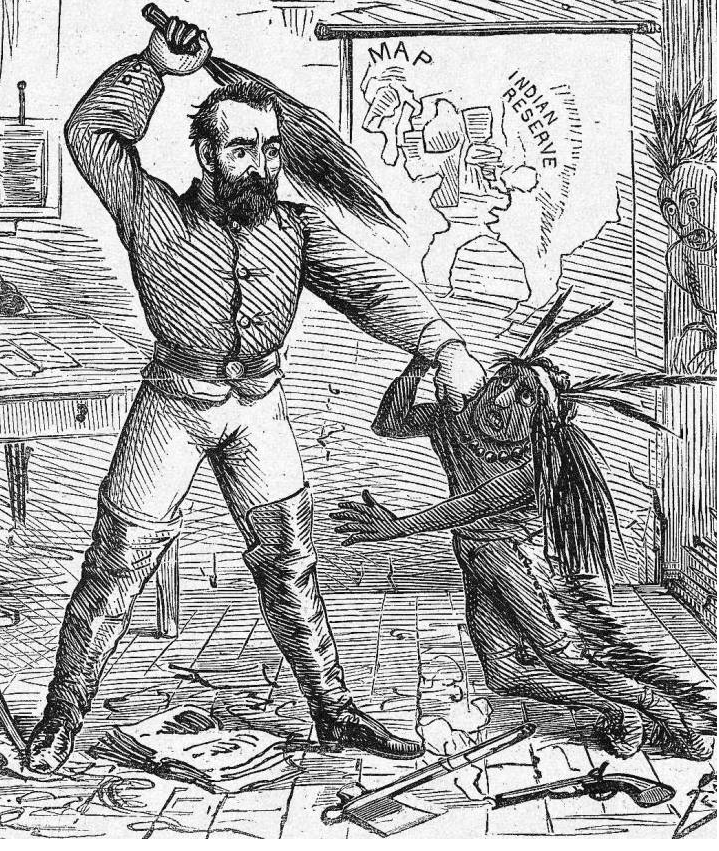
untitledThird, often when we are critical of the decisions and actions of those who lived before us, we don’t have a full understanding of history which was the reality that dictated our ancestors’ actions. For example, when people condemn the United States’ treatment of Native Americans, there’s a lack of understanding of not only the warfare that already existed between the tribes which resulted in the taking and losing of lands and shifting of tribal/national borders even before Western people’s arrival in North America. Engaging in war to increase boundaries was an accepted practice by Native Americans just as it was by European powers, American colonists and later the Untied States. After years of colonizing and imperialism however, we now view expansion through war and conquest as repulsive, but that was the norm of the day, even viewed as spreading the positive aspects of the conqueror’s culture.

Today’s judgement of our early American leaders is also stoked my pacifist thinking which denies any possibility of a “just” reason for war against Native Americans (or others) and the accompanying possession of land and property. However, a “just war” perspective applied to our early history can produce a more acceptable explanation for their actions both as defensively preemptive and in response to attack. While there is ample evidence of war for expansion, there is also ample evidence of Native American attack of established colonies, farms and homes, not to mention alliances with European enemies of the United States.2

While the United States has made its share of mistakes, especially when viewed through 21st century sensibilities, Americans can still be proud of its accomplishments and achievements and be thankful for the help that God has provided the early colonists and later citizens, as we have grown and learned from our history and even the mistakes it has made, to go on to be a blessing to many needy and oppressed people around the world and right here in North America.

So enjoy your thanksgiving without guilt. Enjoy time with your family and friends. Give thanks for the many blessings that God has given you. Continue to be thankful that God is helping our country to be better.

– – – – – – – – –

.

.

.

.

.

.

We should still give what we can, even sacrificially, to help meet the needs of others as a compassionate act of Christian love. But while doing this, we need to urge the government to do all they can to bring about an increase in the number of jobs available and help those receiving entitlements to do all they can to work, when they are able to.

This is not to defend the failure of the U.S. to adhere to treaties or any trickery used to make deals with Native Americans.

Photo credits: Family, HuffingtonPost.com; Indian & Soldier, USHistoryScene.com

.

.

.

Leave a comment

Loyal Soldier or True Christian?

As a chaplain, I am often engaged in conversations with Soldiers about life, death and their spiritual journey. Most Soldiers expect that a chaplain will talk about eternal things while most chaplains hope that Soldiers will be receptive to their concern. This exchange between chaplain and Soldier is not new. I recently came across a newspaper from 1864 in which a Civil War chaplain shares a story about a similar conversation he had with a Soldier dying from a battlefield wound.

Chaplain Jacob Eaton

Chaplain Jacob Eaton, 7th Regiment, Connecticut Volunteers

“After crossing the James, we ascended to the elevated plane which lies between this river and the Appomattox. This brought us upon the old familiar ground where we were encamped and fought last summer. The soldiers of the gallant 7th will long remember the “Bermuda Hundred Sin”. Here are sad reminders of our bloody struggles. Again I stood beside the graves of those noble men and valiant soldiers, Sergeants Nichols and Edwards. I was reminded of the last hours and last words of the kind-hearted heroic Edwards. I recalled and relived the bright but bloody morning when I entered the old log house, where he lay in one corned on a rude bunk, sinking slowly and surely into a soldier’s grave. He had only three months longer to serve. With bright hopes and fond anticipations he looked forward to the day when he would return to his happy home in New Haven-to his beloved wife and noble boy. And how anxiously the loved ones awaited his return. How many little things they did, how many preparations they made in view of the joyous meeting. He had been spared during nearly three long years of exposure, hardship and battle. Could he be taken now from all he loved on earth, from the  wife and child who had so often prayed, so much longed for his safe return? Yes, for God’s ways are not always our ways. He does not afflict willingly, nor malignantly, but wisely, tenderly, for our profit. The sergeant did not expect to die when I entered the room where he lay. He was wounded the night before, and Dr. H. pronounced his wound “superficial” -not dangerous, not fatal. But the seal of death was stamped on his manly face. He had nearly reached the outer limit of life when I called.

“Wiping away the tears and repressing my emotion, I said calmly, “Sergeant, it is my painful duty to tell you that you are mortally wounded and must soon die.” His look of anxiety and disappointment I will not attempt to describe. “You will not let me die before I once more see my dear wife and beloved child! Oh, I cannot be denied this privilege, this blessing, “said the heroic sufferer. This cannot be, I replied, and as your spiritual friend and teacher I advise you to leave whatever messages you have for your wife and child, and make whatever arrangements you think necessary concerning your worldly interests. Then he was calm. He lift messages tender and expressive for those who were waiting his return. He gave directions for the disposal of his effects, and for the education of his little son. Then looking into my face, he said, with a calm, firm manly voice, “Chaplain, I will die like a true and loyal soldier.” I am glad to hear you speak thus, I said; but, sergeant, are you prepared to die like a true Christian? “I have thought much on that subject of late, Chaplain, and I do want to cast myself in humble, heart felt penitence upon the atoning merits and infinite mercy of Christ.” I prayed with him. He became calm, hopeful, happy in that Holy One, who, in the fullness and freeness of his love, forgave the dying penitent on the cross. Soon after came the death struggle, and the brave sergeant, the kind husband, the loving father died in my arms. Then we laid him to rest in the burial ground, where sleep many of is brave comrades. Oh, Virginia, your soil will be held as sacred in all time to come, for the hero and patriot dead who rest in thy bosom.”

.

.

.

Story from “A Chaplain’s Notes from TEF 24th Corps. Camp 7th Regiment, Conn. Vols., Dec. 24, 1864” which appeared in The Hartford Evening Press, 28 December 1864.

The rest of the article written by Chaplain Eaton can be found at “A Chaplain’s Notes.”

Photo from WorthPoint.com

.

.

.

Leave a comment

To Those Who Are Afraid After the Election…

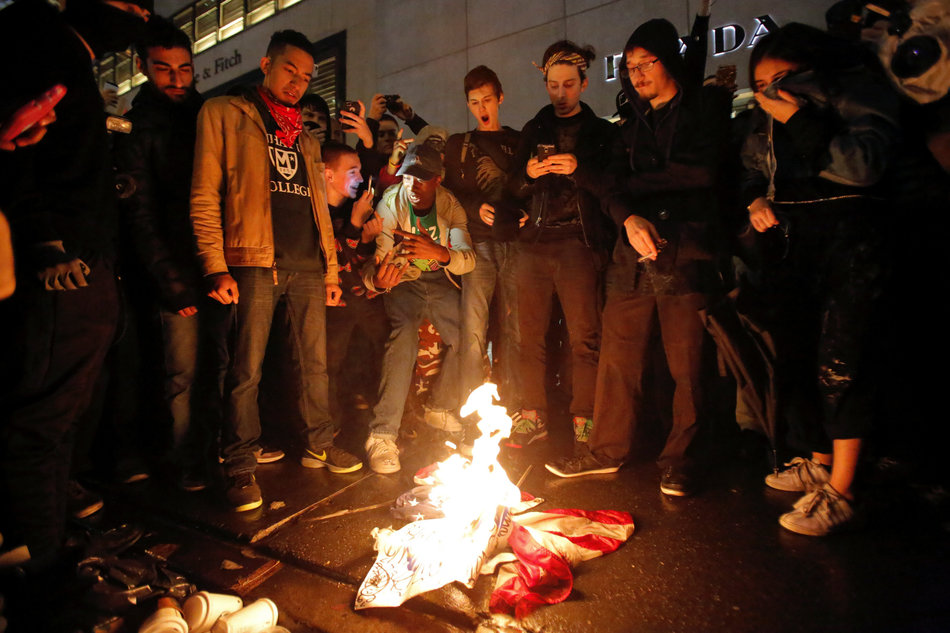
Demonstrators burn the U.S. flag outside Trump Tower during a march against President-elect Donald Trump in Manhattan, New York, U.S. November 9, 2016. REUTERS/Andrew Kelly

Demonstrators burn the U.S. flag outside Trump Tower during a march against President-elect Donald Trump in Manhattan, New York, U.S. November 9, 2016. REUTERS/Andrew Kelly (from HuffingtonPost.com)

I’ve noticed that posts and comments since election day have been only mildly less vitriol than before the election. The difference now, however, is that instead of warnings about the damage so-and-so would cause the country if he or she is elected, they now revolve around what seems to be a personal fear about what will happen January 20th, as though that is the date set for the end of the world. There seems to be so much fear that in some quarters, it has translated into a hatred that is driving people to the streets in protest.

At first, I assumed these posts were just more of the fear-mongering that the left perpetrated throughout the election (and I believe some still are) but as I listened better, I realized that there are some genuine fears out there. I think that much of what people are reacting to is what has been instilled by the political campaign rhetoric that has tainted this presidential election. Opponents of both candidates have warned about the calamity that would come if the other candidate is elected and now we see that being translated into real concern that all of the warnings they have heard  from their side will come to pass in the worst way possible. I have to admit, if I believed all of the political sound bites, I’d be scared too.

What I would imagine frustrates those who are experiencing real fear (and those trying to support them) is the fact that people on the other “side” seem to discount their fears while they admonish them to just accept the will of the people and unite behind the new president. In defense of the other side, I don’t think that most of them don’t care  about those who are afraid, but rather they just don’t understand why anyone would be afraid, seeing things through the filter of the “right.” On the flip side, I think those who are struggling with the outcome of the election are also viewing things through their own filter, preventing them from seeing what the right sees as reality. What I want to try to do now is remove, or at least reduce, that filter in hopes that I can relieve some of the fear some of my friends may be experiencing by explaining what those on the right are actually thinking. Of course, I can only speak from my own knowledge and experience.

Immigration. One of the fears that I have heard from friends and television commentators is that immigrants are going to be immediately separated from their families and deported while others will be restricted from entry into the U.S. Compounding those fears, by some reports, are Trump supporters who have been emboldened by an election win, “terrorizing” anyone who even looks like an illegal immigrant, urging them to pack their bags and leave the country. There’s no making excuses for people’s prejudice and their showing disrespect to anyone, but what everyone needs to realize is that they don’t represent the entire Republican party or anyone else who may have conservative views on immigration.

The truth is, regardless of one’s views on immigration, there’s little chance that anyone would support the tearing apart of families when some of them my be legally in the U.S. While deportation may be stricter on those who aren’t here with family or who have committed serious crimes, more likely than not, any new immigration legislation would provide a route to becoming a legal resident to avoid the splitting up of families and the expense of mass deportations. So who should be afraid of Trumps immigration policies? I think only those who have committed violent crimes or present a serious risk to law and order. Besides all of that, as Trumps campaign advanced, he backed off of full-blown deportations.

LGBT Rights. Another big fear is one that has been very much in the news for the last several years, the rights of the LGBT community in the United States. Some are afraid that their marriage certificates will become worthless and they’ll lose the legal rights given to them through marriage. They fear that President Trump will, with the stroke of a pen, nullify all of the rights the courts have given them over the past few years. While many on the right do view homosexual acts as sinful and thus homosexual marriage as morally wrong, the expectation that current rights will be taken away is a stretch. There is little to no evidence that any new legislation or any court decisions having been overturned ever resulted in a retroactive removal of previous granted rights. That is to say that if a couple is legally married today, the overturning of any court decision that made that marriage legal would not make their marriage illegal, but only future marriages. So while LGBT rights advocates may have reason to fear the future of some so-called rights, they shouldn’t fear the removal of rights already granted through legally obtained marriages.

A surprising fear that I have heard related to the LGBT community is that “conversion therapy” will be mainstreamed, subjecting gays to inhumane treatment in an effort to “fix” their homosexuality. This caught me by surprise because I thought the success of conversion therapy had long-since been debunked. Additionally, the idea of forcing any kind of treatment on an unwilling subject is the stuff of Nazi Germany, not 21st century United States. One of the selling points of the Trump Train was individual rights. It’s not likely that a foundational right like would be violated with forced medical or psychological treatment would ever come to fruition.

Obamacare. Otherwise known as the Affordable Care Act, the “repeal” of Obamacare creates another fear in some people, afraid that they will lose their insurance or coverage while they suffer with illness or injury. The idea of repeal without replacement could be worrisome, but while most of the time when President-elect Trump talked about Obamacare he only talked about its repeal (as have most other Republican candidates this election season) at least once he said that with the repeal will come a replacement plan that will take better care of American citizens than Obamacare did…and cheaper. Additionally, Paul Ryan, Speaker of the House, has talked about a replacement plan that the Republicans have ready to go to improve on what Obamacare tried to accomplish. And just like any other insurance plans, if one is replaced by another, preexisting conditions would be covered since the insured didn’t have a choice in the change in plans.

Abortion. One of the most defining issues among people on the right also brings fear to those on the left. The fear comes from the idea that the government will remove their right to make decisions about their own bodies, which is a foundational right (as mentioned above in the discussion about conversion therapy) and if threatened, Americans should be afraid of their loss of rights. However, this fear is more based on differing political views than on personal rights. People who oppose abortion do not view it as a choice about the mother’s body, but the baby’s, thus making abortion illegal protects the rights of the baby not remove the rights of the mother. But I think the left already knows how the right thinks about that.

Still, Republicans and Trump are very vocal about overturning Roe v. Wade which would remove what the left views as a right; but after 43 years, the likelihood of that happening is slim to none. What I think the Republicans will try to accomplish is the limiting of abortions to only earlier in the pregnancy, mandating the notification of parents of underage children seeking an abortion and removing federal funding of most abortions. Abortions needed to preserve the life or health of the mother or in the case of rape or incest will likely continue to be widely accepted and funded. The left does have a valid argument that it seems like the abortion rate goes down with Democrats in office, primarily because more funding goes to prevention among those more dependent. Republicans need to take this into consideration and be more involved in underprivileged health care and pregnancy prevention. But, to be afraid that suddenly women will not be able to make decisions about their own bodies will not happen, and even about early-term abortions is unlikely.

Climate Change. This may be the fear that I most don’t understand. Maybe it’s not so much a fear as a frustration, but still a hot topic for those lamenting today. It seems like people on the left believe those on the right just don’t care about the planet while people on the right believe that those on the left have bought into irrational fears of global destruction. I can’t speak for everyone on the right, but I don’t think that the majority completely deny global warming. They may question the extent, but global statistics through the years do indicate a change in climate. I think that most (at least some) believe that global warming is not man-made. Geological and archeological scholarship shows that the natural ebb and flow of the earth’s climate brings about a cooling and warming of the planet. For example, when I was in Iraq, I saw satellite images that revealed an additional two rivers (which, by the way, are mentioned in the Bible as flowing into the Garden of Eden along with the Tigris and Euphrates) clearly visible in the Persian Gulf which at one time were flowing through dry land. I also visited the ancient city of Ur, near Basrah, which in its heyday was a port city. Now it’s many miles from the coast. These show a natural movement of waters as a result of global warming and cooling. A natural, repeating occurrence in Earth’s history.

Regardless of how we view climate change, how we treat the planet continues to be contentious. Reconciling the issues of planet-care is not likely because how we view the use and mining of fuel is so different. One group sees retrieving and using fossil fuels as detrimental to the planet while others view the impact to the planet as less detrimental compared to the expense of alternatives and the harm to developing countries who can’t afford the development and use of alternative fuels.  Bottom line, there will never be agreement on our approach to fueling American’s thirst for a lifestyle that requires massive amounts of fuel but it shouldn’t cause a debilitating fear for either side, only impetus to communicate with each other and work together toward acceptable compromise.

Hate & Bigotry. There is no denying that some of the things that President-elect Trump said during the campaign can be viewed as hateful or bigoted. Especially early on, it seems like he often spoke off the cuff without putting much thought to his words. As the campaign progressed, however, he did begin to show better restraint and sensitivity to others and some of his comments that the left uses as examples of his hate and bigotry are simply taken out of context or magnified beyond the original significance. At any rate, Trumps words  do not justify any hate or bigotry that may continue to be spewed by others. Additionally, people make their own decisions and are responsible for their own words and actions just as Trump is responsible for his. Should people be fearful? I don’t think so. The introduction of a more uncouth President does not increase the number of hateful and bigoted people in our country, they’ve always been there. The likelihood of any supposed hate or bigotry residing within the new president influencing domestic or foreign policy is also very low. While the president has a lot of power, he does not govern alone and the Constitution is still the basis of law. What is needed instead of a return of hateful words is a commitment from both sides to not accept words and actions of hate but speak out against them and behave in ways that make attitudes of hate unwelcome.

I’m not sure if anything that I’ve written has reduced any of the fears some people are feeling but hopefully at least we will better understand where each other are coming from and realize that most people are not against those on the other side. And we care.

.

.where

.