Leave a comment

Humanitarian Assistance Mission to Jangadam Afghanistan

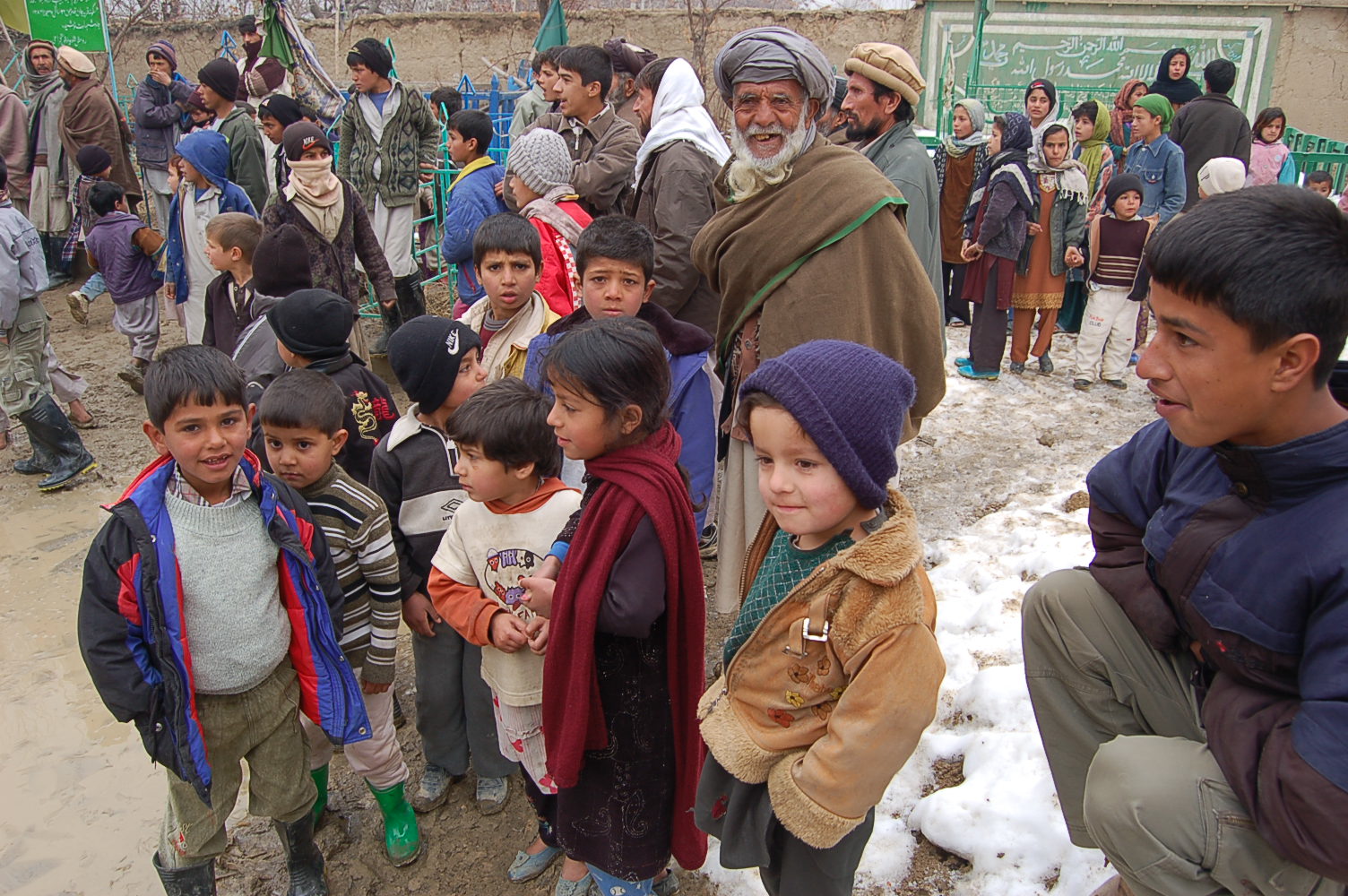
It was an international activity as we convoyed about thirty minutes “outside the wire” to a nearby village in Afghanistan in December 2006. Our team was made up of Soldiers from my unit, the 25th Signal Battalion, as well as Soldiers from Base Operations (BASOPS) on Bagram Airbase. We were accompanied by 2 Polish gunners and met up with Soldiers from the Afghan National Army (ANA). We all converged on the small village of Jangadam to distribute clothes, shoes, gloves, scarves, hats and toys received from caring people in the United States.

The planning for this trip started several weeks before as I was making contact with BASOPS and the Post Chaplain for our Afghan School Project. As we discussed possibilities, it came together that we could participate in a Humanitarian Civil Assistance (HCA) mission that month. I jumped on this as a great opportunity to not only help the people of Afghanistan but also give my Soldiers a reason for being here. Seeing who we are trying to help gives motivation to the day-to-day work our Soldiers are engaged in.

As we prepared for the mission, we were told that there were about 250 families in the village. We obviously wouldn’t be able to give everyone a new wardrobe, but we could provide some help that could maybe get them through the winter. We took supplies for that 250 families then when we arrived found out that there were many more who had gathered in hopes of receiving some assistance. About half way through our distribution, we had to cut back from giving two bags (the size of a plastic grocery bag) to just one per family hoping it would stretch our gifts to cover the whole crowd. Next we ran out of socks, then hats, then finally nearly everything was gone.

We were fortunate in that the village elders were in charge of the crowd and we distributed the gifts at their direction. They kept the crowd under control and with them giving the supplies they were strengthened in their roles in the village and it helped to give a positive view of our forces for those who have so much influence with the people. Even with their help, as we packed up, there were some children who were disappointed and even angry that they didn’t receive anything. We were saddened by the number of children with bare, cold hands that we didn’t have enough gloves to cover. I was determined to get more and come back before winter was over.

But even with those who we could not help, the ones whose names were called, as they went through the line receiving their allotment, clumsily uttered probably 2 of the few English words they knew, “Thank you.” It was nice to see the smiles on their faces as their names were called and it was their turn to go through the line. It made me and my Soldiers feel good that we could do something to help, even if it was just for a few. At least some Afghans would be a little warmer that week.

Before we left, the village elder thanked me for coming to his village and giving what we could. He told me to let him know if he could do anything for us.

That struck me as very strange.

It was very clear that they had so little and we had so much, but he offered his help to me. It showed me how much he, and his village, appreciated the little bit that we could do.

7 Comments

Thanksgiving, Family and Pop Wylies

There are a couple of holidays a year that cause me to reminisce.  One of them is Thanksgiving.  Some people may have many memories of Thanksgiving from their childhood,  I have one.  From my earliest memory, I recall going to Marion, Ohio for Thanksgiving at my grandparents.

Even before there were that many grandchildren, the house on East Farming Street was filled with family waiting for dinner necessitating splitting up to get a place to sit.  The living room would have those interested in football, watching whatever game was on.  Often the kids would be in the dining room playing a board game until we were shooed away so the table could be set for dinner.  The kitchen would have another group, usually sampling the goodies while discussing the happenings of the past year.

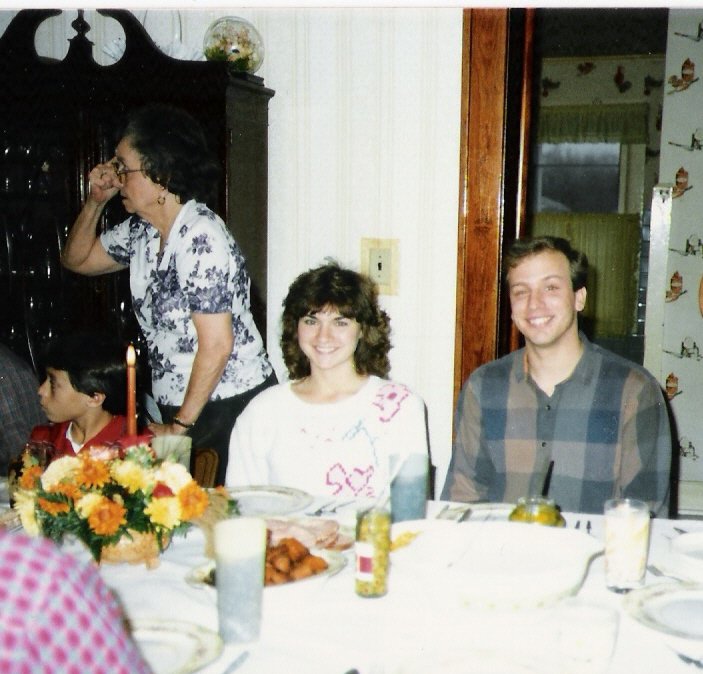
Thanksgiving 1973(?)

I remember the times when my family was able to go up the night before, I would get up early, really early, and find grandma already hard at work in the kitchen, making sure the turkey was properly prepared and in the oven in time to be ready for the hungry mouths that would congregate there in just a few hours.

Oddly, one of my memories of our trips to Marion include a journey into the basement with grandpa.  It was an old basement full of all kinds of wonderful things that a kid would love to explore.  As I remember, my annual visit often included a “gift” from that basement.  Some years it would be an old toy that my uncle had played with when he was a kid growing up there. Other years it might be something that grandpa had made for one of his kids, having been many years since it was stowed away in this “treasure room.”  Sometimes the gifts were even more sentimental like a stack of patches grandpa retrieved from discarded flight jackets after World War II ended, his uniform “leggings,” or his Army knapsack still showing the wartime notation on the bottom, “SGT John J. Finn, North Africa.”  I didn’t hear many stories from grandpa about his time in the Army.  Now that I’m older and have gone to war myself, I think I understand why.

Thanksgiving 1975

The big Thanksgiving Dinner was always the highlight of the visit. Multiple tables would be strategically arranged in the dining room to make room for the family.  As the group continued to grow, once we squeezed into our place in the back, getting out would require the shuffling of at least a half a dozen others so you wanted to be sure you used the restroom before being seated, because you could be stuck a while!

Dinner always included all of the usual Thanksgiving fare.  The turkey, of course, with homemade stuffing (none of the Stove Top stuff!), mashed potatoes and gravy, cranberry salad and sauce, and all of the rest.  Dessert would bring more choices than could easily be decided, so you would have to try a little of each!

After dinner  there were a variety of other activities that are still vivid in my memory. Strangely, though, I don’t remember the clean up, but I do remember retreating to the living room to watch the Thanksgiving Day Parade eagerly waiting for the Jolly Old Elf’s appearance at the end of the parade, signalling the beginning of the Christmas season (obviously, this was many years ago.  Now Santa is competing with Halloween for attention!).

Another tradition was the walk that the “men” would take after dinner.  Often there would be the humorous (and after many years, expected) comment about being hungry and needing to get something to eat.  Usually the walk included a stop at Pop Wylies, a gas station & convenience store a few blocks away.  I remember a few times trying to talk dad into buying me something, anything.  Though he’d always question how I could possibly be hungry after just eating such a big dinner.  Sometimes though, my Uncle Don would step in and buy me a candy bar or bag of chips.  Satisfaction!

I’m sure that we made other trips to Marion to see my grandparents but it’s the trips at Thanksgiving that I remember.

Thanksgiving 1987

Not long after grandpa died, grandma moved down to Cincinnati, nearer to her daughter and family. Of course, now living in an apartment, she couldn’t host Thanksgiving anymore so Aunt Mary Ann began to host it with grandma there to see that everything went right.  Those were good times: the gathering of family, a great meal, watching the game.  But it wasn’t quite the same as Thanksgiving in Marion.  Later when grandma passed away, Aunt Mary Ann hosted Thanksgiving a couple more years –and those were great times too– but distances to travel and busy schedules caused my participation to fade away.

Over the last several years since then, my immediate family has attempted to make Thanksgiving a significant holiday for us to get together.  But with kids in Chicago, Akron and Mansfield Ohio and us in Missouri, that is nearly impossible.  These days we sometimes have a smaller dinner with just the family who is still at home, or we enjoy Thanksgiving with other families, which are always great dinners and an enjoyable celebration of Thanksgiving;  but nothing has measured up to my memory of Thanksgiving in Marion.

Thanksgiving 1987

I’ve begun to think forward a bit and now wonder if sometime in the future, as my wife and I become grandparents, our home will be a place where our children and grandchildren will gather for Thanksgiving Dinner.  I suspect that as we gather, I will tell them about my childhood memories of Thanksgiving at grandma and grandpa’s in Marion.

Maybe these new times of  family gatherings at our home to give thanks will be the beginning of memories for my grandchildren.  Maybe when they’re older, they will reminisce about their Thanksgivings at grandma and grandpa’s as a smile slowly forms on their faces.

.

7 Comments

Obamacare vs. Religious Freedom

(photo from:  http://www.house.gov/content/learn/)One of the major areas of concern about Obamacare, at least for people of faith, is the requirement that businesses of a certain size must provide, through their insurance, certain aspects of “health coverage” that are contrary to their religious beliefs.  Strictly religious organizations (i.e. churches, synagogues, mosques) are exempt from this requirement but “businesses” that are run by religious organizations (i.e. hospitals, orphanages, schools) are not exempt. Additionally, for-profit businesses aren’t even considered for an exemption regardless of the religious views of their owners, Board of Directors or business plan.

The Roman Catholic Church has been the most prominent religious organization to challenge the HHS mandate, claiming that providing abortifacient, contraception and sterilization is contrary to the religious beliefs of the Church and as such, a violation of their First Amendment rights.  One of the more publicized businesses to make this claim is Hobby Lobby, though the Administration has declared that as a “secular” business, they are not entitled to First Amendment freedoms.

Essentially, the current Administration is attempting to redefine what healthcare  is as well as who is entitled to religious freedom.

In an article on the Forbes website, James Poulos provides what I think is a good explanation of this debate and the challenges that are ahead:

.

Obama, Religious Liberty, And The Constitution

The 1st Amendment directly expresses the Constitution’s clear ‘bias’ in favor of religion. The first words out of the gate in the Bill of Rights are “Congress shall make no law respecting an establishment of religion, or prohibiting the free exercise thereof[.]” If you’re freely exercising religion, that is, you’re better protected than if you’re trying freely to express something that’s like religion but, crucially, not. Mere moral preferences do not receive the same protection. Nevertheless, the Supreme Court has characteristically interpreted religion and free exercise about as broadly as possible. And, like the Court, Americans have tended to view the exercise of religion as a important and privileged variety of free expression in general. Rarely are religious observances prohibited. Cults that face persecution or prosecution abroad do okay here. Heresies are often tolerated and widely practiced.

So even though the Constitution favors religious practices over merely moral preferences, constitutional law and American common sense approve of defending shared lifestyle commitments and convictions. That makes for two types of pro-religious culture. They aren’t often in tension. But that may be changing.

Read more

.

UPDATE:  More news on the businesses, schools and Church groups suing against the HHS mandate of Obamacare can be found in this article on the Christianity Today website.

UPDATE:  This article on The Becket Fund website has new information on the Hobby Lobby fight against providing the abortion pill for its employees.

1 Comment

The Parable of the Persistent Widow for Today

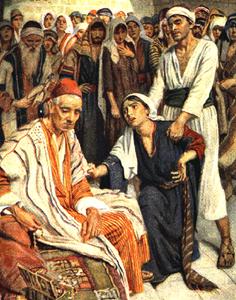
(Photo from: http://access-jesus.com/Luke/Luke_18.html)As the future grows bleak and some wonder what it might hold or how bad it may get, it is important to remember that Jesus taught that just prior to His coming, things would get really bad, nothing like what we may experience in the next few years.  I’m not one who carries a sign and cries, “the end is near!”  I don’t even spend much time studying end-times prophecy.  I am one, however, who takes seriously Jesus’ admonition to watch and be ready; with “being ready” as the thrust of that admonition.

With that in mind, however, Jesus does offer some help for when times are tough. While Jesus was talking about really tough times- like when you don’t pause to gather your belongings before high-tailing it out of town, or you dare not attempt to go back to your house from the field before running for safety; I believe that the help He offers is also available today when Christians feel like things are bad enough to call on Him, really call on Him.  Let’s look at this parable to see how to access that help:

Then Jesus told his disciples a parable to show them that they should always pray and not give up. He said: “In a certain town there was a judge who neither feared God nor cared what people thought. And there was a widow in that town who kept coming to him with the plea, ‘Grant me justice against my adversary.’

“For some time he refused. But finally he said to himself, ‘Even though I don’t fear God or care what people think, yet because this widow keeps bothering me, I will see that she gets justice, so that she won’t eventually come and attack me!’”

And the Lord said, “Listen to what the unjust judge says. And will not God bring about justice for his chosen ones, who cry out to him day and night? Will he keep putting them off? I tell you, he will see that they get justice, and quickly. However, when the Son of Man comes, will he find faith on the earth?” (Luke 18:1-8, NIV)

To correctly understand this parable of the Persistent Widow found in Luke 18:1-8, we must be sure that we understand the preceding passage which has Jesus telling His disciples about coming trouble.  This passage in Luke 17:22-37 equates the days before Jesus’ return with the days before the judgment of the world in Noah’s lifetime and the days before the judgment of Sodom in Lot’s lifetime.  Jesus makes clear that life will be going on as usual, eating, drinking, marrying, etc.  This seems to agree with other statements of Jesus where He makes clear that people of the earth cannot fully know the day or the hour of His coming.

This passage in chapter 17, however, indicates extremely difficult times, from which escape will be difficult and those being plucked away in that persecution and/or judgment will be swift and apparently indiscriminate.  It is in these terrible days that Jesus says the disciples will be driven to long for the day when He was physically with them, offering His sound wisdom, comforting words, and powerful intervention.  His disciples of future generations will also long for days that they had not known, but will greatly desire Jesus’ physical presence.

It is to these fearful days that Jesus brings the teaching on prayer that we find in the parable of the Persistent Widow.  The Biblical author introduces the parable with his suggestion of why Jesus shared this parable with his disciples:  “to show them that they should always pray and not give up” (v. 1).

The judge that Jesus describes is one likely not recognizable to Christians today.  21st century judicial systems, at least in the developed world, are generally fair and impartial so that someone bringing their case before the court can be reasonably assured of fair and just treatment.  Today’s Christian needs to try to imagine a judge who has no regard for the rule of law, no fear of personal retribution for his rulings and no real concern for people who come before his bench.  This is the type of judge which Jesus presents in this parable.

The widow who Jesus introduces could be more easily recognized by 21st century Christians.  Many people today know that little old lady whose husband died years ago and who either never had children or whose children don’t live near her and therefore offer her little assistance.  Before he died, her husband squeaked out a respectable, but meager, living which now barely provides for the essential needs of his surviving wife.

Now this widow finds herself in need of legal help, “justice” as Jesus puts it.  As she peruses the docket, she discovers that her deepest fear is realized.  Again, her case was assigned to the worst judge in the county, the one who seems not to care at all about her case and has little concern for how much she needs his help.  But again, just as she has done countless times before, she patiently pleads her case to the inattentive judge, hoping that maybe this time he will show some compassion and find in her favor.

But relief, yet again, eludes her.  Once again the judge denies her request and once again she goes home discouraged, hopeless, alone.  But still, as often as she can get her case on the docket, she goes back to the courthouse.  And just as often, she gets that same judge who continuously denies her request.  Until one day, after countless retellings of her complaint and repeatedly hearing the “whack” of the gavel accompanied by the angry word from his lips, “denied!” she hears the unexpected.  The judge relents; he gives in to her request and grants her relief.

The judge readily admits that  he has little concern for her case, that he does not care whether she gets the help she needs or not, but he is sick and tired of her constantly coming before him and wasting his time with the same old complaint, week after week.  So to finally be rid of her, he grants her request.

In our passage, Jesus contrasts this judge who “neither feared God nor cared about men” (v. 2) to the Heavenly Father.  All of the original readers would understand that the Heavenly Father is nothing like this unjust judge.  Christians today, with the benefit of the rest of the Bible, know that God cares about all of His creation.  He cares about the needs and burdens of His children, His disciples.  Everyone who knows God knows that He hears their prayers.  In this contrast Jesus asserts with His ratorical question what should be obvious to all who believe, “And will not God bring about justice for his chosen ones, who cry out to him day and night?” (v. 7)

But Christians should be careful not to confuse this loving and caring God with a judge similar to one I came before once as a teenager during my wild oats-sewing days.  I found out after I got off with a minimal fine that he was known as the “freedom judge” because he so often lets people off, or with only minor fines.  God will not give to those who ask Him anything they want.  He will not just be the go-to-God for any whimsical desire or shallow plea.  To see the answers that God wants to provide, believers need to seek, as they  pray, the divine will of God in their situation.  It could be deliverance, healing or rescue.  Or perhaps it could be grace to persevere in the midst of trials or inner peace that allows one to live within  a society without peace and full of turmoil.  It may be  healing, deliverance or rescue that is provided by the passing from this life to the next.  Or, sometime in our future, it may mean martyrdom, dying for your faith.

So Christians today need to be aware that there are difficult days ahead.  They may feel that after the recent election that this country is in the midst of those days, but rest assured that this is nothing compared to the days that are coming just before Jesus returns to the earth.  There will be persecution; there will be great fear as everyone wonders who can be trusted or who may be watching who to report to the authorities for their Christian witness.

When these days come, or even when Christians experience difficult days in their lives today, Jesus wants them to remember that God will hear their prayer for help.  He will see as they earnestly come to Him with their request, praying for the will of God to be accomplished in their lives and their world.  But as this parable reveals, it is those who pray persistently, who come to Him “day and night” (v. 7) who will receive His sure and effective answer.

Jesus concludes this parable with the rhetorical question, “However, when the Son of Man comes, will he find faith on the earth?” (v. 8) The Christian’s faith grows with every answer to prayer that God provides.  The Christian’s faith grows as he or she observes God’s hand at work.  The Christian’s faith grows as obedience and holy living produces the promised results of an abundant and full life.  So as Christians live their lives as the Scripture teaches, their faith will ultimately grow and this faith, along with that of millions of other Christians around the world who have also persevered, will greet Jesus when He comes in the air to receive them unto Himself, answering His question with a resounding, “Yes, He will find faith on the earth!”

3 Comments

The Crisis of a Second Obama Administration George Weigel

Here’s a good article for my “thinking” readers, from the Archdiocese of Denver website (linked to by Juicy Ecumenism).

While written as a consideration of the Roman Catholic crisis it is equally applicable to Protestants.  We face/will face many of the same concerns as the Roman Catholic Church.  Instead of sitting back and letting the Roman Catholics fight the battle alone, we should see it as our “fight” as well and not sit quietly by while our religious freedoms are stripped away from us under the guise of “progress” and “tolerance.”  Consider the article:

.

The Crisis of a Second Obama Administration

by George Weigel

Nov.14,2012 – President Obama’s re-election and the prospect of a second Obama administration, freed from the constraints imposed by the necessity of running for re-election, have created a crisis for the Catholic Church in the United States. In the thought-world and vocabulary of the Bible, “crisis” has two meanings: the conventional sense (a grave threat) and a deeper sense (a great moment of opportunity). Both are applicable to the Church in America these next four years.

The immediate threat, of course, is the HHS (Health and Human Services) mandate requiring Catholic institutions and Catholic employers to include coverage of contraceptives, sterilizations, and abortifacient drugs in the health insurance offered to their employees. The legal challenges mounted against this obvious violation of the first freedom, religious freedom, may well be vindicated. But with Obamacare now seemingly set in concrete, the Church will face a host of such implementing “mandates” and it will be imperative to contest those that are morally unacceptable, time and time again. Authentically Catholic health care in America is now in mortal danger, and it is going to take a concerted effort to save it for future generations.

A further threat comes from the gay insurgency, which will press the administration to find some way to federalize the marriage issue and to compel acceptance of the chimera of “gay marriage.” Thus it seems important to accelerate a serious debate within American Catholicism on whether the Church ought not pre-emptively withdraw from the civil marriage business, its clergy declining to act as agents of government in witnessing marriages for purposes of state law.

Continue reading

11 Comments

Secession, Really?

All this talk about secession is about the most ridiculous thing that I’ve seen happen in our country for some time!  At this writing, the count is up to 49 states who have filed petitions to peacefully secede from the United States.  What is even more amazing is that these petitions are making the news.  Why?  This isn’t even news.  This whole secession thing is no more newsworthy then the leaves that blew off my tree from the wind last night!

What makes it even more frustrating is all the blogs and Facebook posts and opinion pieces that are raising these petitions as serious issues, for example, racism.  Come on, really?  By my count, just eleven of the petitioning states are southern states who seceded prior to the Civil War; the rest are mid-western or northern states.  Some are red states while many are also blue states.  How can you draw from these petitions that it is a race thing?  While I certainly don’t support the idea of secession, my assessment of the 707,738 who signed these petitions is that it is not because a black president was reelected but because a president was reelected who supports issues, not just opposed to many conservatives, but who opposes them to the extreme and with vigor.

But that’s for another post, let me get back to the topic of secession.  Why do I find these petitions for secession and the accompanying assumption of news-worthiness so ridiculous?

First, the petitions being signed have no legal or Constitutional authority.  These are petitions on the White House “We the People” website.  What is this website for?  So the president can hear from the American people. What will the White House do with the petitions on this site?  According to the website, if any petition received 25,000 signatures, “White House staff will review it, ensure it’s sent to the appropriate policy experts, and issue an official response.”     Just to show the seriousness of some of the petitions on the site, there is one that has 472 signatures so far that is titled, “Have President Obama Do the Hokey-Pokey.”  Now this is the place to bring serious issues!

I’m not disparaging the website, it’s a great idea.  If enough people are concerned about a particular issue, the White House will look into and respond to it.  But it has no legal authority!  The most that petitions on this site will accomplish, if they get the required 25,000 signatures, will be to cause the White House to look into it and issue a response. What will that response be for the secession petitions?  “You can’t secede.”

But you say, “it still let’s the president know that people aren’t happy with him, that they don’t like what he believes in, they don’t support what he’s doing with the government.” True, but don’t you think the 59,141,316 votes for Governor Romney(photo from: http://www.solidprinciples.com/blog/the-gops-cold-comfort/2012-election-final-state-results-blue-red-map/) and 1,931,237 votes for other presidential candidates (including 49,426 for Roseanne Barr!) tell him that? This doesn’t even count the throw-away write-in votes for Jesus, who isn’t even eligable to serve as President of the United States-nor do I think that He would want to!  After all, President Obama just had 51% of the popular vote, he must have figured out by now that the 49% of Americans who didn’t vote for him, in some way disagree or don’t approve of him.

Second, these petitions show the world and other Americans that we are a divided country.  It’s true that in some respects we are divided, after all, we have a number of different political parties, all sorts of Political Associations and Lobbies, and any number of publications and websites where we battle out our differences.  But with all of our differences, when the election is over real Americans come back together to work toward a better America.  We don’t seek to separate ourselves.  The actions of the signers of these petitions just create a wider division in our country than there needs to be.

We can (and need to) continue to have our different beliefs about the issues.  We need to debate them and seek to convince the “undecideds” that our way is best. We need to prepare for the next election and work to get our issues supported and our candidates elected.  But we do this as Americans, not as independent states.

Third, The number of signers on these petitions are miniscule.  Consider the population of the United States:  308,745,538.  Compare that to the number of signers (at this writing) of these petitions: 707,738.  That’s a whopping  0.22923019538504227 percent of the populace, well under 1%!    Less than 1/2 of 1% in fact!  Let’s compare them to those who voted on election day, about 123,688,647.  Those who have signed the petition are just 0.5721931779235971 percent of the electorate who voted in the last election, that’s just barely over 1/2 of 1%.So really, these petitions are meaningless because they represent such a small amount of the American people.  The number involved in these petitions is so insignificant that they shouldn’t receive any attention at all, much less all of the attention they are getting.  Here’s an update (15 Nov 12): According to an article on the Washington Times website, a University of North Carolina Sociology professor had one of his classes take on these petitions as a project.  One of the things they discovered in their detailed analysis was that, “As of 7 a.m. Thursday, there were 789,453 signatures, but since many people had signed more than one petition, the class concluded that fewer than half, or 281,780, were unique.”  This just makes the numbers even less significant and therefore, even less noteworthy.

(photo from: http://en.wikipedia.org/wiki/File:Texas_State_Capitol1.JPG)Fourth, a petition from citizens to the President of the United States is not the way a state would secede anyway.  The state’s legal business is performed by the elected officials of that state.  I would imagine that it would be the state Attorney General, by direction of the state legislature with approval of the governor (depending on the percentage of the vote from the legislature) who would file the legal papers with the Federal government for the peaceful withdraw from the United States.  More likely than not, this would still be preceded by a vote by the people of that state. So all of these petitions on the We the People website aren’t even the legal way to go about the whole process of seceding.  If they’re going to start a petition, it should be to their state legislatures for them to take it up while in session.

Finally, the bottom line is the states are not permitted to “peacefully withdraw from the United States of America.”  Many of the petitions quote from the Declaration of Independence, which is a fine document in deed:

“When in the Course of human events, it becomes necessary for one people to dissolve the political bands which have connected them with another, and to assume among the powers of the earth, the separate and equal station to which the Laws of Nature and of Nature’s God entitle them, a decent respect to the opinions of mankind requires that they should declare the causes which impel them to the separation.”

“…Governments are instituted among Men, deriving their just powers from the consent of the governed, that whenever any Form of Government becomes destructive of these ends, it is the Right of the People to alter or abolish it, and institute new Government…”

But what they must not understand is that the Declaration of Independence was our declaration to the King of England.  While it has many nice sentiments and we can gain much insight into the thinking of our founding fathers, it is not a basis for law.  United States law is based on the United States Constitution and even though there is no provision forbidding secession,  I find no provision in it allowing for a state to withdraw from the United States either.

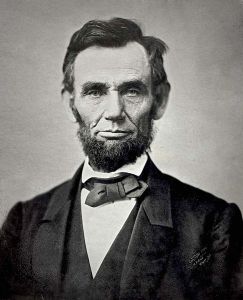
There was a little-known war a few years back.  Maybe you’ve heard of it.    Those in(photo from: http://en.wikipedia.org/wiki/File:Abraham_Lincoln_November_1863.jpg) the south sometimes call it “The War of Northern Aggression.”  Some in the north called it the “War of Secession.” It’s common name is “The Civil War.” Whatever you call it, it pretty much settled the issue of secession from the United States.  If anyone wonders about that, it is very likely that the United States today could use the same rationale that President Lincoln did to allow for Federal troops to ensure that the States remain United. He contended that since there was Federal property in those states, such as Post Offices, forts and arsenals, that the the Federal government had a right to secure Federal property and prevent the states from seceding.  Lincoln actually had pretty good Constitutional grounds for his argument. Section 8 of the Constitution states,
The Congress shall have Power . . . To exercise Legislation in all Cases whatsoever, over such District (not exceeding ten Miles square) as may, by Cession of particular States, and the Acceptance of Congress, become the Seat of the Government of the United States, and to exercise like Authority over all Places purchased by the Consent of the Legislature of the State in which the Same shall be, for the Erection of Forts, Magazines, Arsenals, dock-Yards and other needful Buildings;”

From the Constitution and from history we see that the question of secession has been settled.  States can’t do it.

So the only result coming from all of these petitions to secede is the growth of accusations, bitterness, fighting, and division.  All of this at a time when our country needs to come together and see what we can do to make things a little better, even if it is just at the local level where all of us can get involved.

So what would be my advice to all of those who started and signed the petitions for their states to secede from the United States?

Grow up!

.

____________________

You might also enjoy:

Election Results and the Church

Hope After the Election

What About the Third-Party Candidates?

The Falls Church’s John Yates on Elections, Governance and Christian Responsibility

Is Murder OK As Long As My Taxes Are Lower?

1 Comment

This poem is very good. (To me) it tells of the Christian willing to sacrifice some of what they could have to help others find the way. Very powerful, please take the time to read it!

Gregory Crofford's avatarGregory Crofford

Sam Shoemaker (1893-1963) served as a pastor in New York City and Pittsburgh. He was instrumental in establishing the spiritual foundation for Alcoholics Anonymous, particularly the need to turn to God as a way of coming out of alcoholism.

Rev. Shoemaker, toward the end of his life, wrote “I Stand by the Door” (aka “I Stay Near the Door”) as an apology for his ministry. I first heard the poem in 1983 during a devotional time at the beginning of Church History class at Eastern Nazarene College, taught by Joseph Seaborn. The poem struck me that day and ever since by its simplicity and vision; what’s more, I’ve found it crosses cultures.

The version of the poem below is from an online tract. The only change that I have made is to update the language, making it gender inclusive.

———————–

I stand by the door.
I neither go too far…

View original post 549 more words

3 Comments

Hope After the Election

Even Christians can, at times, feel a little down and discouraged.  Big events in life, like a national election, can cause moods to swing dramatically, especially if they have been deeply involved in the issues.  But regardless of how disappointed one may be, I contend that there is hope after the election!

The worship services at my church are seldom mundane.  More times than not the Holy Spirit moves in a dramatic way which causes us to raise our voices in praise and adoration to the Father.  Many Sundays, the text and the message that my pastor presents speaks to me right where I’m at.  This past Sunday was no exception.

Like many other Christians I have been a little discouraged following the elections on Tuesday.  I’m still a Christian, and I  know that this is the temporal world and what really matters is that God is still on the throne.  Still, I felt a little down.

The text of Scripture my pastor read this morning really addressed  my discouragement.  He read from Romans chapter 8, the verses which spoke to me were 35-39:

Who shall separate us from the love of Christ? Shall trouble or hardship or persecution or famine or nakedness or danger or sword?  . . . No, in all these things we are more than conquerors through him who loved us.  For I am convinced that neither death nor life, neither angels nor demons, neither the present nor the future, nor any powers, neither height nor depth, nor anything else in all creation, will be able to separate us from the love of God that is in Christ Jesus our Lord.

I saw in this passage two big thoughts for me:  1) Believers are more than conquerors through Jesus Christ.  We’re not losers, we are the victors, the winners, the conquerors!  The election may have not gone the way  that we would have liked it to, but in Jesus, we are still conquerors.  It’s encouraging to be on the winning side!

2) The second thought that I got from this passage is that regardless of the outcome of the election, regardless of the direction our country goes, regardless of how bad things get in my life or in the world around me, nothing can separate me from the love of God!  Nothing, nada, zilch, zero!   God’s love for me is guaranteed and there’s nothing that can come between me and God’s love.

And you know what?  That applies to you, too!

Our candidate may not have won, but there is really no reason to be down or discouraged, we are still more than conquerors.  We may see policies and legislation come to pass in our country that is morally repugnant, but that or anything else can not keep us from God’s love.

What should be more exciting for us?  Who is in the White House or having the love of God?

So cheer up!  Be encouraged!  God loves you and nothing can separate you from that love!

Leave a comment

We need to remember to pray this Sunday … and every day … for the persecuted Church around the world! (some day we may need their prayers for our persecution!) Here’s a history of “International Day of Prayer for the Persecuted Church” by IRD . . .

Institute on Religion and Democracy's avatarJuicy Ecumenism - The Institute on Religion & Democracy's Blog


By Faith McDonnell

This weekend holds another special event, in addition to the 237th birthday of the United States Marine Corps on Saturday, November 10, and Veteran’s Day on Sunday, “eleventh hour of the eleventh day of the eleventh month.” November 11 is also the annual observance of the International Day of Prayer for the Persecuted Church (IDOP). This year marks the 16th anniversary of this special day to remember those persecuted for their faith around the world.

I was privileged to be part of the coalition that created IDOP. Convicted by the realization that more people had died for their Christian faith in the twentieth century than in all the previous centuries combined, our coalition first met on January 23, 1996 at a meeting convened by Nina Shea, the director of the Center for Religious Freedom (then at Freedom House, now at The Hudson Institute). The…

View original post 221 more words

31 Comments

Election Results and the Church

The commentators and pundits are still trying to explain what happened Tuesday (I’ve yet to listen to any of them!).  About half of Americans are celebrating while the other half are discouraged.  Some feel like things are hopeless for America and that we are doomed, while others feel that President Obama will lead America to new heights.

I fall somewhere in between.  I had a very definite opinion of who I thought should be elected president based on how I weighed the issues informed by Scripture.  Some of my thoughts on that can be found in my other posts like “Is murder OK as long as my taxes are lower?” and “What about the 3rd-party candidates” so I won’t go much into that here. I would like to share what I think I see in the results of the balloting on Tuesday and the Exit Polls.

Worship Attendance

It was interesting to note from the Exit Polls from Tuesday that the more often one attended worship services, the more likely they were to vote for Governor Romney.  This suggests that perhaps because they attended church more often they heard from their pastor, Religious Education teacher or some other leader about the issues and what the Bible says about them so they knew how to vote.  Maybe though, the fact that they attended worship services more often is indicative of their deeper commitment to their faith which caused them to vote according to the Biblical teaching on the issues and therefore the candidate who best support them.

This result was true for Roman Catholics, as well.  I believe that they had more of an incentive, and likely had more specific instructions from their priests, because of the current threat to religious liberty in how “Obamacare” is attempting to force them to provide contraception and abortifacients when acting as an employer, contrary to their religious beliefs.

Women Voters

Another interesting note from the Exit Polls was the high percentage of women who voted for President Obama.  55% of all women voted for President Obama compared to 44% for Governor Romney.  This increases to 75% for Latino women and 96% for black women while he still received 43% of the vote from white women. I know that a lot of the campaign advertising late in the campaign portrayed Governor Romney as “dangerous for woman’s health” so I’m interpreting much of the women’s vote as a vote for abortion-rights, though I realize that there are many other issues that concern women and abortion-rights is just one of them.  Of all of these women, do none of them believe in the sanctity of life or are all of them more concerned about being able to kill their unborn babies if they get pregnant?

Black Voters

Something else that the Exit Polls revealed is that 93% of blacks voted for President Obama.  I think this is the highest percentage of any of the results of the Exit Poll. This is regardless of their age (though it drops to 91% for black males between 18-29), gender, religion, income level, family status, education level, anything!  I don’t want to be accused of being racist–because I’m certainly not, but how could this 93% be, except that it is because President Obama is black.  I find it hard to believe that 93% of the blacks in America are in agreement with all of President Obama’s philosophies.  Do none of these 93% believe that abortion is wrong?  Don’t any of them believe that homosexuality is immoral and dangerous for society?  Are none of them concerned about their religious freedoms?

I think another of the statistics from the Exit Polls reveals more in relation to the “black” vote.  The candidate quality that matters most to those who selected the President, at 82%, is “cares about people like me.”  I believe that since President Obama shares skin color with the 93% of the black Americans who voted for him, there is an identification, the “like me” that brings a feeling of, “he knows what I go through, he knows where I’m at, he cares about me.”

I’m not necessarily saying that this is bad, I’m just saying that to vote for someone because you identify with his skin color and feel a commonality that may bring an understanding of shared experience to bear on policy to the exclusion of Biblical values on things like the sanctity of life or immoral marriage relationships should be called into question.

Now, I realize that many of the 93% of blacks who voted for President Obama may very well have agreed with all of his policies and stands on the issues, or at least enough that they felt that a vote for President Obama was their best option.  I get that.  My question is more about those black voters who have strong Christian convictions on such things as abortion and homosexual behavior, who instead voted for President Obama.

White Voters

The flip side of my argument is also true, however.  It would be wrong for someone who is white to have voted for Governor Romney just because he is white or to have not voted for President Obama just because he is black, which doesn’t seem to have been the case since 40% of whites voted for President Obama compared to just 58% for Governor Romney.  Whether black or white, it is important that the issues, the priorities, the philosophies of the candidates and their parties are seriously considered and weighed against the Bible and God’s will and placed above any concern for, or even serious recognition of, one’s skin color or ethnicity.

Other Results

In other election results from Tuesday, same-sex marriage became legal in Washington, Maine and Maryland.  This is the first time that this has been done by a vote by the people instead of by the legislature forcing it on its population or the court declaring it to be so. And it appears that a measure in Minnesota to amend their constitution to define marriage as between one man and one woman has been defeated, though gay marriage is still illegal under Minnesota law.  What’s more, in Colorado and Washington, marijuana use for any reason became legal, and Wisconsin elected the United States’ first openly homosexual Senator.

The big question that I have about all of this is, “where were the Christians?”

According to recent research by the Pew Research Center, 73% of Americans identify themselves as “Christian.”  The same research reveals that only 48% say that they are “Protestant” with only 19% being “White Evangelical” (can’t find a column for “Black Evangelical,” it seems like there should be some) and  22% identified themselves as Roman Catholic.  Throw in the “White Mainline” (15%), “Mormons” (2%), “Orthodox” (1%), “Black Protestant” (8%) and “Other Minority Protestant” (6%) and we have our 73% Christian.  This doesn’t even take into account the 6% “Other Faiths” and the 19.6% “Unaffiliated” which includes atheists, agnostics and “nothing in particular” who at least some of which would be sympathetic to some of the same issues that Christians are concerned about.  I point out these numbers to suggest that the elections should have looked differently on Tuesday if biblical teachings held any place of prominence in the lives of American Christians.

So where were these 73% (+/-) on election day? I know that many of that number can be eliminated since they are part of mainline or other denominations who have a more accepting view of many of these issues.  But are there not enough Christians who believe what the Bible says, to defeat or at least slow, the forward stride of these issues that are at variance with the Bible?

Perhaps not.  Perhaps the number of Christians who believe and accept the Bible as God’s Word for our life today is diminishing, as is reflected in the above mentioned research (this is the 1st time Protestants have dipped below 50% in U.S. history!).  Perhaps Bible-believing Christians are becoming a very clear minority.  Perhaps they will soon not even be a sizable enough voting block to be recognized by the parties or candidates.

If this is the case, the future of America is very dire, indeed.  If there are not enough Christians to prevent the spread of abortion, perverted marriages, illicit drug use and other evils that are proven to destroy families and societies, then the United States is destined to become merely a footnote in history.  Christian Americans are likely to live as a minority in an increasingly hostile culture with open persecution of Christians not far behind.

I don’t know if things are hopeless yet, or not.  I do believe however, that more education of Christians as to the importance of their vote as well as the direction of their vote is essential.  I believe that “strategic alliances” may need to be engaged in to move toward the defeat of commonly opposed issues.  More than anything, though, I believe that Christians need to pray more than they ever have.  They need to pray for their leaders and decision makers.  They need to pray for their communities and their country.  They need to pray that God will change hearts and minds.

But in addition to praying, we need to get out there, we need to “go.”  I believe that more effective than legislation on moral behavior is evangelism.  If we win our communities for Christ they won’t want to engage in immorality or sin.  If we enable God’s movement in our communities and allow Him to work in us and through us to bring about revival in our land, the issues will become less of an issue.

Richard Stearns, President of World Vision, in an opinion blog on The Huffington Post website put it this way:

. . . we need to go back to the basics of living as disciples of Christ, living missionally for Christ and demonstrating the Gospel in tangible ways within our schools, workplaces and communities. . . the fight over symbolic issues is backfiring, alienating people from the truths of the gospel rather than attracting them to it. The kind of Christianity the world responds to is the authentic “love your neighbor” kind. Its appeal can’t be legislated through court battles and neither can courts stop its spread.

Don’t get me wrong, I still believe that we need to work through our government and legislators to limit immoral behavior like abortions, homosexual marriage, drug use, neglect of the oppressed, and the like.  But as we engage the government, we need to engage our communities empowered by the Holy Spirit and moved by the needs we find around us.  We need to work from the ground up and from the inside, out to change our country.  We need to start with ourselves, yield ourselves to God and His use.  Then we need to change our communities through engagement, evangelism and compassion.  As our communities are won, our counties will follow, then our states, then our country!

As Winston Churchill said when England was embroiled in World War Two, “Never give in. Never give in. Never, never, never, never–in nothing, great or small, large or petty–never give in, except to convictions of honor and good sense.”  He went on to urge:

Do not let us speak of darker days: let us speak rather of sterner days. These are not dark days; these are great days–the greatest days our country has ever lived; and we must all thank God that we have been allowed, each of us according to our stations, to play a part in making these days memorable in the history of our race (29 Oct 1941 at Harrow School).

Let me now borrow Churchill’s words: never give in, never, never, never, never!  God is able to work in our country in greater ways than we can imagine. He is able to use us, as we are willing and allow Him, to change our communities into God-fearing communities! He is able to use this growing army of Christians, young and old, to continue the flow of salvation and compassion until one day, we will be able to tell our grandchildren, “yes, I do remember those days when it seemed all was lost; those days before the great revival swept our land!”