Leave a comment

Here I Sit: 2012 in Review

The WordPress.com stats helper monkeys prepared a 2012 annual report for my blog.  I thought you might be interested in seeing it . . . though I’d imagine I was more interested in it than you likely will be!

Here’s an excerpt:

600 people reached the top of Mt. Everest in 2012. This blog got about 2,000 views in 2012. If every person who reached the top of Mt. Everest viewed this blog, it would have taken 3 years to get that many views.

Click here to see the complete report.

2 Comments

Message of Hope for Christmas

Every Christmas season, we are reminded of that famous newspaper article of years past assuring little Virginia that there is a Santa Claus.  That was long ago, when Christmas brought with it many long-held traditions and getting through the season was simpler and not so hectic.

tacky_christmas_decorations_640_01Now, every year, it seems that the Christmas decorations go up earlier and earlier.  I remember when if they were up at Thanksgiving, they were up early – now we see some before Halloween!  And the decorating also seems to be centered more on Santa than on the Christ child!

The stress on families at Christmas seems to be increasing, as well, as they attempt to “keep up with the Joneses.”  Children insist on the latest styles and name brands, causing parents to extend themselves financially beyond their means, or to feel guilty or frustrated because they aren’t able to buy all that they would like.  All of this certainly takes the joy out of the Christmas season and causes us to wonder, like Virginia, if there is some wonderful person that cares for us.

A recent Time Magazine article reported how many of the stories and people of the Bible are being proven through archeological discoveries.  There is one story of interest to us at this time of year that every major character has been identified as having actually lived.  It is found in Luke, chapter 2. It is the story of the first Christmas; it tells of the coming of Jesus into the world.

In those days Caesar Augustus issued a decree that a census should be taken of the entire Roman world. (This was the first census that took place while Quirinius was governor of Syria.) And everyone went to their own town to register.

So Joseph also went up from the town of Nazareth in Galilee to Judea, to Bethlehem the town of David, because he belonged to the house and line of David. He went there to register with Mary, who was pledged to be married to him and was expecting a child. While they were there, the time came for the baby to be born, and she gave birth to her firstborn, a son. She wrapped him in cloths and placed him in a manger, because there was no guest room available for them.

And there were shepherds living out in the fields nearby, keeping watch over their flocks at night. An angel of the Lord appeared to them, and the glory of the Lord shone around them, and they were terrified. But the angel said to them, “Do not be afraid. I bring you good news that will cause great joy for all the people. Today in the town of David a Savior has been born to you; he is the Messiah, the Lord. This will be a sign to you: You will find a baby wrapped in cloths and lying in a manger.”

Suddenly a great company of the heavenly host appeared with the angel, praising God and saying,

“Glory to God in the highest heaven, and on earth peace to those on whom his favor rests.”

When the angels had left them and gone into heaven, the shepherds said to one another, “Let’s go to Bethlehem and see this thing that has happened, which the Lord has told us about.”

So they hurried off and found Mary and Joseph, and the baby, who was lying in the manger. When they had seen him, they spread the word concerning what had been told them about this child, and all who heard it were amazed at what the shepherds said to them. But Mary treasured up all these things and pondered them in her heart. The shepherds returned, glorifying and praising God for all the things they had heard and seen, which were just as they had been told.

nativity-scene1When you get tired of seeing the decorations, when you get caught in the busyness of the season, when you run out of money before you run out of gifts to buy, and when you find yourself wishing that there really was a Santa Claus who cares about you, remember that story in Luke.

Remember that God cares for you.  Remember that Christmas is about Jesus coming to earth to die for you.  Remember that there is a Savior.

I would like to improve on the words of the editor who wrote to Virginia and give to you a message of hope for this Christmas season:  Yes, America, there is a Savior!

.

.

.

(Originally written by Daryl Densford and published, exclusive of Scripture text and pictures, December 23, 1995 in the Daily Sentinel, Rome, NY. Photo credits: Decorated house from http://izismile.com/2010/12/23/tacky_christmas_decorations_42_pics.html; Nativity scene from http://fellowshipofminds.wordpress.com/tag/nativity-scene/)

.

.

2 Comments

She may be in Hell because of me . . .

hells-flames

Whenever I think of her, I nearly always see her looking at me through the blazing flames of Hell.  She isn’t saying anything but in her eyes I see her question, “Why didn’t you tell me?”

While I was attending Nazarene Bible College in Colorado Springs Colorado, I had the opportunity to work as a Youth Director at a “Mainline” church.  Many would label this church as very liberal, certainly not a place where you would find an evangelical, holiness Christian!  I took the position, however, believing that it would be good experience for me while I was in school preparing for the ministry.  I thought that it would be a great opportunity for me to share the Gospel message of God’s love since the church’s Executive Council told me that they wanted their teenagers to learn the Bible; this in spite of the fact that one of the officers of the church unhesitatingly declared, “we don’t get saved here.”

Just to give you an idea of how “liberal” this particular church was, the pastor who had just left before we arrived had been known for teaching reincarnation.  The pastor who was there while I was, both denied the existence of a real Satan or Devil as well as reminded me that there are many roads up the mountain to God; while we’ve chosen Christianity, others have chosen other paths equally “good.”  Needless to say, you didn’t hear any evangelistic appeals from the pulpit.

Still, my time at this church turned out to be an eternally successful one.   We drew in teens from the community who had never been in church before.  They were learning more about the Bible and the God revealed in it.  And, despite the declaration against “getting saved,” we had teenagers who did just that and testified to their lives being changed.

Ministry within the youth group was great and we were integrating them into the larger church with involvement in worship and a teen choir.  Still, while my family was in attendance at every worship service and became friends with many of the members, we felt that our evangelical persuasion kept us at arm’s length.

One Sunday morning this feeling revealed itself to me more than it ever had before, but the separation wasn’t being enforced by them but by me.

SanctuaryThis particular Sunday morning as the pastor was sharing the needs in the church before the pastoral prayer, he mentioned one particular woman who was in the hospital, her cancer having progressed dramatically.  This woman and her husband were active in the church and my wife and I experienced a modest friendship with them.

As the pastor mentioned her name I heard God speak to me in a way that I had never heard before and only occasionally since.  I didn’t hear an audible voice, but it was just as clear as though it was.

God very clearly told me to go visit that woman in the hospital and tell her about Jesus, invite her to accept Him as her Savior.

I couldn’t believe what God was asking me to do!  The excuses started rolling out in my mind:  I barely knew her, it would be so awkward to visit her in the hospital.  I was just the Youth Director, that wasn’t my place.  I had been told that they didn’t “get saved” at that church, how could I suggest it?  I imagined the pastor scolding me for over stepping my bounds and bringing what I believed into that hospital room ignoring what they believed.

I convinced myself.  I didn’t go.  I disobeyed God.

Once that Sunday morning service was over, having produced what I believed was a solid case against God’s request, I didn’t think much more about it.  That is, until the next Sunday.

The pastor was again sharing the needs of the congregation before prayer, but this time the request wasn’t for that woman but for her grieving family.

She had died that week.

Suddenly, all of the excuses that I had made for not going to see her and sharing Jesus with her seemed so ludicrous.  I realized that God had a plan for her to hear the Gospel one more time before she died and that plan included me, but I refused to participate in it.  Rather, I chose to disobey His command to go.  Since that Sunday, I haven’t been able to escape the thought that my disobedience may have caused her to wind up in Hell.

This event in my life is not just something I just remember, it is something that I am tormented by.  The sight of her looking at me through the blazing flames of Hell asking me through the pain in her eyes, “Why didn’t you tell me?” continues to torment me to this day.

Now, I know the comfort that I would attempt to offer someone in my shoes, were I their pastor.  I would assure them that God likely had a plan “b” in case I didn’t follow His call.  I would remind them that likely she had previously had the opportunity to receive Christ, that God is faithful in that way.  I would contend that it was her sins and rejection of Jesus that would land her in Hell, not my disobedience.  I  know all of these things, but they don’t bring me comfort because I was the one who disobeyed God that day.  I was the one who possibly prevented her from hearing about Jesus one more time before she died.  I was the one who God had asked to go.

Whenever I am tormented by this memory, my prayer is always that God had sent someone else to her, that she had another opportunity despite my disobedience.  I also pray that God would help me to never let that happen again, that He would give me the strength, courage and words to go and speak to someone when He says to go.

I share this story not so that you would feel sorry for me.  I don’t even share it as a therapeutic exercise.  I share it so that maybe you can learn from my mistake –no, my disobedience– so that you would not have to endure the torment that I have  (and likely that she has).

I encourage you not to delay if God nudges you to speak to someone about Jesus.

I challenge you to see others through the eyes of God so that you might see their needs, then reach out to them to help meet those needs.

I plead with you to be obedient when God calls on you, when He points someone out to you to speak to.  Obey Him.  Your obedience may not only free you from being tormented for years as I have been, but may also bring a new soul into the Kingdom of God.

.

.

Photo credits:  face in flame- http://imageshack.us/f/824/manflames.jpg/;  hospital visit- http://www.lourdes.com/ patient-guide/visiting-hours

.

2 Comments

Are We Responsible for Another Person’s Choices?

Prince-William-and-Kate-Middleton-leave-hospital-in-London-1212-3

Prince William and Kate Middleton leaving hospital in London

The Australian DJs who pranked the hospital where British royal, Kate Middleton, was being treated have reportedly lost their jobs, or at least have had their show suspended.  While the prank itself, received much publicity and air-play, Jacintha Saldanha, the  nurse who the DJs convinced they were the Queen and Prince Charles, has apparently committed suicide.

This incident raises the question, “are we responsible for another person’s choices?”  Or maybe it would be better asked, “when do we become responsible for another person’s choices?”

The DJs, Mel Greig and Michael Christian, I’m nearly certain, would quickly answer “no!” while I’m pretty sure that  Jacintha Saldanha’s family would say “yes!”  Is it appropriate to blame these DJs, who were doing what they often do as part of the entertainment that on-air personalities provide their listeners?  Should they be held responsible for the choice that Jacintha Saldanha made to end her life?  Or are the decisions that we make our own?

This question is strikingly similar to one asked in the Jewish Tanakh, when God asked Cain where his brother Abel was.  Cain curtly replied, “I know not, am I my brother’s keeper?” (Genesis 4:9, LXX) The similarity sadly continues when we note that Cain had just killed his brother.

The implication of this passage, and much of the rest of Holy Writ, is “yes, you are your brother’s keeper.”  Or brought back into our situation, “yes, we are responsible for another person’s choices.”

This needs to be qualified, however.  If we are just going about our own business and someone makes a poor choice; clearly, we’re not responsible for that.  Additionally, if we are attempting to help someone the best that we know how, by getting them help; or confronting them about dangerous things they are doing in their life; or even sharing with them what we believe God says in His Word about their lifestyle; and we’re doing these things with love and tact, then here again, I don’t believe that we’re responsible.

Australian DJs Mel Greig (left) and Michael Christian

I believe that responsibility comes when we are mean-spirited, have evil intentions, or even if we are careless in how we treat people.  Responsibility also comes, I believe, when by our actions we cause someone to do something that we know is wrong.

In the Christian Scriptures, Jesus makes this clear when he says, “If anyone causes one of these little ones—those who believe in me—to stumble, it would be better for them to have a large millstone hung around their neck and to be drowned in the depths of the sea” (Matthew 18:6, NIV).  I know that we’re not certain if Jacintha Saldanha believed in Jesus, or not, but the principle that Jesus presents in this passage is that we should value other people and be careful not to cause them to do wrong.

If you are wondering if the DJs actually caused Jacintah Saldanah to do “wrong,” I would suggest that England has similar laws such as HIPAA, in the Unites States, making the sharing of confidential medical information illegal.  Even if it was just a violation of hospital policy, this could be enough to cause Jacintah Saldanah to feel as though she had done wrong.

Another clear teaching of both Jewish and Christian Scriptures is to “Love your neighbor as yourself”(Leviticus 19:18 & Mark 12:31, NIV).  Loving our neighbor as ourself should cause us to think before we make someone the butt of our jokes, recipient of our pranks, subject of our name-calling, or victim of our hate.  I doubt seriously that these DJs (or any of us) would like being tricked into violating the policy of our workplace, local or federal laws, Biblical or religious convictions, or even our own conscience.  It could even be said that willingly causing someone public embarrassment is a violation of God’s command to “love your neighbor as yourself.”

Jacintha Saldanha

I’m not going to get deeply into the “who is my neighbor” question, but Jesus seemed to make it clear in His parable of the Good Samaritan that your neighbor is anyone you come across who is in need (Luke 10:25-37).  I think that these DJs came across that nurse in need.  She was in need of respect.  She was in need of protection from public humiliation.  She was in need of simply being left alone.  And these DJs, instead of providing for her needs by leaving her alone, acted more like the robber in Jesus’ parable and attacked her, then left her for dead.

We can bring this home and apply it to our lives a lot easier.  Do you simply disregard the needs of people you come in contact with by using your words to hurt them?  Do you refuse to practice God’s command to “love your neighbor as yourself” by simply ignoring those around you who are in need?  Do you not recognize your neighbors all around you as you casually go about your day, not caring who you hurt by your actions or who continues to suffer by your insensitivity or lack of regard for their condition?

The best way to remedy this problem is to adjust your vision.  What I mean by this is choosing to see people through God’s eyes.  Asking God to allow you to see the hurts and needs of people, seeing through their veneer or facade to what is inside.  When we begin to see people as God does, it will be more difficult for us to mistreat them or ignore them.

I have made the decision to see people differently, to try to see their needs instead of seeing what irritates me about them or what I think they’re doing wrong.  I want to see people as God does, so that I can try to love them as God does and then do what I can to help them.


I encourage you to try to do the same.  Accept God’s command to “love your neighbor as yourself” whether you believe in God or not.  Doing the right thing for people can help them to make the right choices, life-honoring choices, choices that you can be happy with them that they have made.  It certainly won’t hurt you and will only serve to make our world a better place to live!

.

.

.

(Photo credits:  Prince William & Kate Middleton, SkyLiving. Sky.com; Meg Greig & Michael Christian, The New York Times Media Decoder; Jacintha Saldanha, Daily Mail online; 2 women, Your Dictionary.com)

1 Comment

Very Inspiring Blogger Award

very-inspirational-blogger

Books at Middlemay Farm has nominated me for The Very Inspiring Blogger Award. Thanks Books at Middlemay Farm, it’s always great to know someone gets inspired from something you write, much less that anyone is reading it!  (I guess you didn’t see my political rants!)

.

Anyway, the rules of this award are:

1. Display the award logo on your blog
2. Link back to the person who nominated you.
3. State seven things about yourself.
4. Nominate fifteen other bloggers for this award and link to them.
5. Notify those bloggers of the nomination and the award’s requirements.

.

Seven things about myself:

1.  I’m an Army Chaplain.

2. I’ve been to 22 other countries (23 if you count the U.S.).

3. I’ve deployed with the Army to Iraq and Afghanistan.

4. I have 5 children, 2 still at home (2 boys, 3 girls).

5. I’ve been married over 25 years.

6. I’m a 4th generation member of the Church of the Nazarene.

7. I nearly drowned as a child after being knocked over by a wave at Myrtle Beach.

.

My nominees are (in no particular order):

1. Heart Murmurs

2. Cristian Mihai

3. Impressions of a Princess

4. As You Go

5. 1000 Single Days

6. Lumberjack in the Desert

7. Gina Left the Mall

8. Scott’s Holar

9. The Timothy Blog

10. Jonathan R. Fisher

11. Connections

12. Hadley Writes

13. Attila Ovari

14. Green Light Lady

15. iChurch of the Nazarene

.

There you have it.  Not sure what it may mean or how legitimate it may be but I did follow the “nominations” back several bloggers just for fun and it keeps going…and going…and going…  I don’t see how it hurts anything and if nothing else it will pass on some pretty good blogs (and maybe even a few more hits).  If you want a “purer” blog of instructions, see my nominator’s at Books at Middlemay Farm.

.

Leave a comment

Reflections on “The Steward Leader”

Major Themes

steward_leaderR. Scott Rodin begins with the point that in the Bible, leaders are not appointed but anointed for service.  He says, “The selection criterion for leadership was not based on who seemed most fit for the appointment, but on whom God had anointed for the task” (p. 14).  This is in contrast to how leaders are selected for organizations, even ministries, today.  He places an emphasis on this anointing further stating “With God’s anointing comes what every leader seeks:  God’s power and presence” (p. 14).  This is woven throughout the book but comes out clearly in the authors later discussion on the leader not owning the position, but being ready to move to another as God wills.  If God anoints a leader for a position, then the decision remains with God as to when and where to move that leader again.

The book is wrapped around the leader as steward in four relationships:  with Creator God, ourselves, our neighbor and God’s creation.    “As God’s people, we are called to reflect the image of our Creator God through whole, redeemed relationships at four levels—with God, with our self, with our neighbor and with creation—bringing glory to God and practicing in each the ongoing work of the faithful steward” (p. 33).  This philosophy fits nicely into Webber’s idea of “participating” with God’s purposes for re-creation in “The Divine Embrace”.

One’s relationship with the Creator God is based on the fact “you and I were created in the image of the God we know in Jesus Christ, who has revealed himself to us as the triune God of grace” (p. 30).  When the leader accepts and believes this fact it enables him or her to maintain a right relationship with God.  The author continues, “When we know with certainty the nature of our Creator God and the image that we bear as his children, we can know with equal certainty the purpose for our existence” (p. 30).  This certainty guides the steward leader in whatever position God has anointed him or her for in addition to helping care for his or her neighbor (employees) and creation (even the lawn around the organization’s building).

The author contends “the one calling of the steward leader is joyful obedience” (p. 62) and that “our vocation is a participation in the transforming work God is doing in us, and it is a process of letting that work transform us as leaders, the people we serve and the organizations we lead” (p. 55).

In all four of the above mentioned relationships, the author shows how the steward leader is free to act when he or she remains a steward of each and refuses ownership.  This freedom allows the leader to make the difficult decisions as well as freely invest in the lives of the organizations employees (since they are not in competition with the leader), the organization (since the leader is merely a steward of it) and God’s creation (since it is not owned but under the leader’s care).

Critical Analysis

RodinOne of the strengths of this book is the authors experience on both sides of the Steward Leader process.  The author readily admits where he had failed in leadership before becoming a steward leader.  He also brings in the experience of living and mentoring steward leaders since his own transformation.

Another strength of this book is the abundant use of Scripture, especially at the beginning of the book as he builds the foundation for the steward leader concept.  Later in the book, he does not seem to bring in Scripture as much, but does go to it to support significant points.  The wise, though limited, use of Scripture keeps him from just “proof-texting” and allows the strength of the support of Scripture to come through better.

I liked this book and the author’s presentation, believing it to be generally well-done so I had a difficult time finding weaknesses, but for the sake of argument, let me share two.

I think that one weakness of the book is the lack of good illustration or practical application of the steward leader concept at work.  He does make clear that it is not a book on leadership and is careful not to provide a how-to or step-by-step guide for leadership, and that practical application will be as varied as the leaders, organizations, and will of God.  However, I think that good examples of some of his concepts would help in both understanding as well as acceptance of his points.

I found another weakness in the last 2 or 3 chapters of the book.  There were at least 3 typographic or typesetting errors.  I realize that sometimes minor mistakes get through in a published work, but when you have a book published for academia (published by IVP Academic) you should ensure a publication is error-free as much as possible.  Additionally, the author is trying to “sell” the steward leader concept, making the point that the steward leader need not be driven by the outcomes of the organization for success if he or she is focusing on the four relationships appropriately since, he contends, God will bless that leader and the organization with the results that really matter.  If this belief is applied to the publication of this book, would not that mean that it should not be burdened by the distractions of errors?

Again, though, I thought this was a good book and a great follow-on to Robert Webber’s, “The Divine Embrace” which I read just before this one.

.

Biographical Information:  “The Steward Leader:  Transforming People, Organizations and Communities” by R. Scott Rodin was published in 2010 by InterVarsity Press in Downers Grove, Illinois.  The International Standard Book Number is 978-0-8308-3878-3.

.

1 Comment

The Christian Life and the Liberal Right

Addie Darling offers a reasonable argument in this post . . . I encourage you to continue reading by following the link (above).

Institute on Religion and Democracy's avatarJuicy Ecumenism - The Institute on Religion & Democracy's Blog

By Addie Darling

Since the election, there have been numerous articles tolling the bell for the death of Christianity’s relevancy in the political sphere, as well as a continuing discussion over the future of Christian political activism. These claims seem to have a point: gay marriage was passed in three states, physician- assisted suicide met a narrow defeat in Massachusetts, and the President was largely supported by Catholics, even given the controversy between the President and the United States Conference of Catholic Bishops over the HHS mandate and its effects on Catholic organizations.

Looking back at the discourse of the past month, I can’t help but wonder if – given the current dialogue- the alignment of traditional Christians with the goals of political parties- particularly the Republican party, will doom any attempt at salvaging a society that values human dignity, the family, and authentic justice. This is not necessarily…

View original post 638 more words

1 Comment

“World’s Best Dad” Review in Buzzbin Magazine

(photo from:  https://www.facebook.com/eddiedoldrum)

From Left to right: Jacob Densford, Jeffrey Quinn Steinwachs, Samuel Hunt and Ryan Sandy.

A couple of months ago I shamelessly plugged Eddie Doldrum’s debut release, World’s Best Dad,  since my son played the guitar and mandolin on it.  Recently the album was reviewed by Buzzbin Magazine, a regional entertainment magazine, so it only seems right that I share that review here.

Before I share the review, let me quickly say that you would not find Buzzbin Magazine on many “prim and proper” Christian’s coffee tables just like you wouldn’t find World’s Best Dad  on their cd racks.  But I’m a proud father and while I look forward to the day when all of my children use their talents in a more God-honoring way, I am still proud of their accomplishments and believe that God can be honored in a variety of ways. While World’s Best Dad wouldn’t be my first choice of music, all of the young men in the band seem to work hard to produce an album worth noticing.

I copy and paste the review here because I wouldn’t want to be responsible for what you may see on the magazine’s site.  Also be warned, the review has a couple “bad” words.

Daryl                    ——-

.

Eddie Doldrum – “World’s Best Dad” Album Review

868081026-1“To make it to the future, we must first get through to the past,” sings Sam Hunt on Eddie Doldrum’s debut EP “World’s Best Dad.”

It’s a lyrical sentiment that could sum up the plight of any northeast Ohio musician who has tried to defend the region through song. Rust Belt artists know the area’s scattered pockets of forward-thinking and optimistic people, who despite economic decline and population loss, are the ones building a future of exciting and important culture. And it’s those residents who wear their optimism like a badge of honor even when cynical politicians and outsiders try their damndest to squelch it.

So it comes as no surprise that the introspective folk revivalists Eddie Doldrum hail from the rubber-padded city of Akron. The band, which originally began as a duo between Hunt and drummer Ryan Sandy, has grown to include Jeffrey Steinwachs (bass) and Jacob Densford (guitar, mandolin). Bright Eyes, or Conor Oberst, is a large and looming influence on Hunt, whose strained, jittery and nervous vocal proclamations make every word sound heartbreaking. Take opener “Tearable Teeth,” for example, which kicks in it all at once with Densford’s mandolin mimicking the acoustic guitars and a catchy electric guitar lick. Here Hunt cries, “Everyday I’m getting better at feeling worse / Yeah, I call that progress, my sadness comes first / There ain’t no word that could bang a drum if it didn’t fucking hurt / Ain’t no way a little boy like me will ever have some kind of worth.”

The vocals sit front and center on “World’s Best Dad” and I suppose they should with such an intense and expressive singer. But more musical diversions would have been welcomed, especially since all five songs glide at a similar mid-tempo pace. Still the quiet-loud-quiet musical performances give songs like “Condolences” a rollercoaster-like dynamic that are textured with a mandolin that weeps, providing a musical sadness to follow Hunt’s lyrics.

From the oblique references to the folk-country revivalist spirit and bitter lyrics, “World’s Best Dad” makes for a suitable alternative if Bright Eyes’ last release left a bad taste in your mouth.

.

Listen to Eddie Doldrum at www.eddiedoldrum.bandcamp.com.

.

ABOUT THE AUTHOR: RYAN SHERIDAN:  Ryan Sheridan is an intern at Buzzbin Magazine. Follow him on Twitter at www.twitter.com/rsheridan.

___________________________.

If you really must, you can see the review in context here.

.

Leave a comment

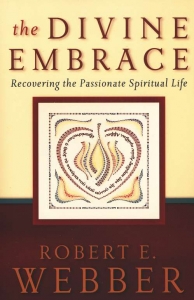
Reflections on “The Divine Embrace”

Major Themes

If “The Divine Embrace” was to be summarized in one sentence, it would be:  “… spiritual life…is union with God fulfilled in a life of contemplation and participation in God’s vision for life in this world” (p. 16).  Dr. Webber goes back to this statement over and over as he explores spirituality in both the early and present church.  This statement is infused with power with another one that appears over and over:  “He stretched out His arms of love on the hard wood of the cross” (p. 125), explaining that it is in the incarnation, death and resurrection that we see renewal and new life of not just the individual, but all of creation.  This, says Webber, is God’s vision:  the recapitulation of the heavens and the earth; this is the vision that we are to participate in as we enjoy the divine embrace providing for us an authentic Christian spirituality.

It is clear that Dr. Webber feels that the contemporary church is lacking in a proper understanding of the spiritual life.  He emphasizes the “proper” display of the Christian spiritual life as he presents the practice of the early church supported by the writings of the church fathers on the way to his plea to restore the ancient view of spirituality in the modern church.

Traveling on this journey from the foundations of the Church to today, Webber shows how the various ages of the church contributed to its losing the authentic practice of the spiritual life he describes.

Webber spends much time elaborating on the Catholic and Orthodox practices that grew out of the early church as an aid to rediscovering this authentic spirituality.  These include the Rules of St. Benedict, the spiritual disciplines, the Lectio Divina, to name a few.  He also presents a heightened view of baptism that leaves no doubt to the reader that he is convinced that this is a sacred and essential rite which the modern church has neglect to its peril.

As Dr. Webber discussed the ancient tools and rites of the faith and their appeal to the younger generation of today I was at first concerned that this was going to be a book supporting the Emergent Church movement with the accompanying criticism of the Church, but as I progressed through the book his love for, and commitment to, the Church grew more evident.  The final chapters solidify Webbers view that it is, in fact, through the Church and its corporate worship (when done properly) that an individual is able to fully find the “Divine Embrace” or authentic Christian Spirituality.


Critical Analysis

Robert E. Webber

One of the strengths of this book is Webbers extensive knowledge of the early Church, the Church Fathers and the Church throughout history which he presents as appropriate throughout the book.  He does not limit his citations to just one or two primary sources, but draws from the vast expanse of the fathers and patriarchs as he unfolds his view of the spiritual life.

Another strength that comes through is Webbers deep background in worship (this is where I was first introduced to his work).  He uses his knowledge and understanding of worship to clearly explain how modern worship services can be improved to be a better conduit for aiding in the worshiper’s growth in the authentic spiritual life which the book is presenting.

A weakness of the book, I believe, is Webber’s limited dealing with faith traditions other than his own.  Undoubtedly, a man of his background would be familiar with more than his own tradition, but in most instances, he writes with the presumption that his readers are in complete agreement.  I do not fault him for believing the way he does and sticking to it, but a work that was destined to have wide appeal should at least make allowance for other traditions.  For example, many of his examples of spirituality that he is proposing, I have seen in the lives of believers who were “entirely sanctified” or “filled with the Holy Spirit” in a way that is beyond his discussion of the Holy Spirit or sanctification.

Another weakness that I see in this book is the way Webber seems to downplay the “crisis experiences” in the life of the believer.  If one just takes what is in this book, they might believe that a person could just slip into salvation without a moment of decision to receive Christ as their Savior.  He suggests that especially in the case of a 2nd or 3rd generation Christian, that the faith of the family often is just passed on to the children without that crisis moment when they realize they are in need of salvation.

I would quickly add, however, that the weaknesses noted above are not a great deterrent to my acceptance of the premise of this book.  I enjoy Robert Webber’s writing and this book did not disappoint me.  While I could see the spiritual life he describes lived out in others only using different terms, he still offers much to consider to help the reader grow deeper in their relationship with God and more satisfied in their spirituality taking part in the divine embrace that Dr. Webber offers.

Over the years I have added several of Dr. Webber’s books to my library after first meeting him at a worship conference that he presented.  As I researched further after completing this book, I was disappointed to discover that Robert Webber passed away back in 2007.

.

Biographical Information

“The Divine Embrace:  Recovering the Passionate Spiritual Life” by Robert E. Webber, part of the “Ancient-Future” series, was published in 2006 by Baker Books, a division of Baker Publishing Group in Grand Rapids, Michigan.  The International Standard Book Number is 978-0-8010-6555-2.

Leave a comment

Post Thanksgiving Hike and a Touching Methodist Civil War Story

This is a touching story of Christianity in action during and after the Civil War:

(Reblogged from Juicy Ecumenism)

Post Thanksgiving Hike and a Touching Methodist Civil War Story

(from:  http://juicyecumenism.com/2012/11/24/post-thanksgiving-hike-and-a-touching-methodist-civil-war-story/)by Mark Tooley, President of IRD

There’s no better place for a post Thanksgiving hike than Bull Run Battlefield in Virginia 30 miles outside Washington, DC. Although I’ve walked it dozens of times, yesterday I explored a new area around Sudley United Methodist Church and discovered a touching Civil War story about the congregation. Union troops streamed by shocked church goers on Sunday, July 21, 1861. Service was cancelled as the brick sanctuary quickly became a field hospital for Union troops. After the Union retreat, Confederate doctors joined the northern doctors who stayed behind, helped by church members. One New Hampshire soldier lying under a nearby fence with a chest wound was left for dead by busy doctors. But a local family who belonged to the church tended to him for many days, even building a makeshift shelter over his spot. He finally recovered sufficiently for relocation to a Richmond prison.

Twenty six years later the old soldier returned to thank the family for preserving his life, including the husband who had later served in the Confederate army.

Continue reading . . .

.