Leave a comment

From Blindness to Sight

Depending on your faith tradition, you may be in the midst of what the Christian Church calls “Lent.” Generally lasting forty days as a reminder of Jesus’ time of temptation in the wilderness, Lent is a period when Christians engage in self-denial to be more focused on prayer and recognition of one’s own need of salvation. Often, Christians abstain from food or other desires and contribute money or time to help the poor as a way to prepare for the celebration of Easter.

Healing of a Blind Man in Bethsaida Mark 8:22-25The Gospel reading from [the Sunday before last] highlights humankind’s need to see our spiritual condition more clearly. In John 9:1-41 we find the account of Jesus healing a man blind from birth. This spectacular event is used to shed light on the religious leaders’ spiritual blindness. They claimed to see and understand God and Scripture, yet denied the power and authority that was found in Jesus as displayed in his healing of the blind man. Unable to see Jesus as the Son of God and Savior of the world, their guilt remained in them, lacking true forgiveness of sin.

The blind man, on the other hand, who acknowledged his inability to clearly see and understand the mysteries of God, heard Jesus’ voice, chose to believe in him, and went on to worship God through Jesus as a sinner saved by the grace of God delivered through Jesus the Savior.

In a world full of sin and depravity, it is often difficult for us to clearly focus on the one who came to live among us and die for us; but without this clear focus, the attractions of this world could easily turn us away from fully following Jesus as we should. As we complete our journey through lent and soon enter the celebration of Easter and Jesus’ resurrection from the dead, I encourage you to join me in seeking a clearer view of Jesus. Reach out to him to grow in closer relationship with him and the Father. Let us live in a way that others may see the love and joy that come through a relationship with Jesus our risen Savior, and come to Jesus as the blind man did, willing to believe and worship him!

.

.

.

Orignally published in the Guidon, 10 April 2014.  It can also be found in the Guidon’s online edition.  All of my Guidon articles can be found here if you’re interested!

.

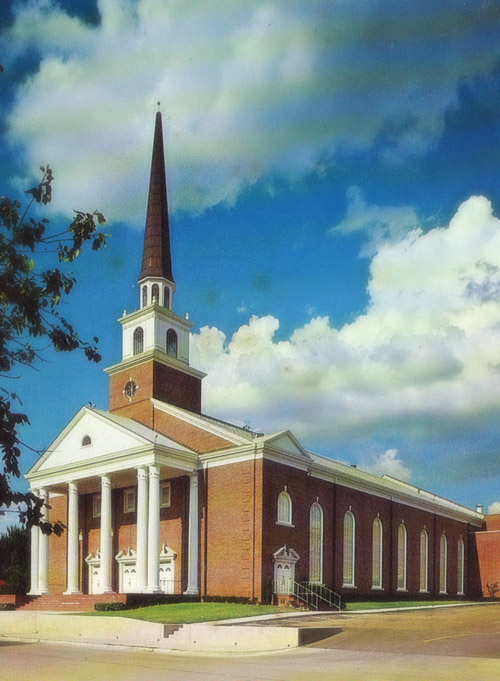
Photo from the Lavista Church of Christ website.

Leave a comment

Freedom of Religion or Freedom of Worship?

Church buildingIt has been a subtle and (for many) an unnoticeable shift  away from the Constitutionally protected “Freedom of Religion” to what the liberal left is calling “Freedom of Worship.” Seeking to silence the Church in the public square and reduce their religious “practice” to what happens during a worship service, some in the government (in the U.S. and around the world) are trying to solidify this shift as Constitutional-when it’s not.  We need to be aware of what is happening and how it can impact the practice of our faith outside of our “place of worship.”  Wesley J. Smith, senior fellow at the Discovery Institute’s Center on Human Exceptionalism, wrote a good article about this issue on the First Things blog that you should take time to read.  The first couple of paragraphs are re-posted here, but follow the link at the end to continue reading.

.

Freedom of Worship’s Assault on Freedom of Religion

by Wesley J. Smith

Until very recently, the West saw religious liberty as a weight-bearing pillar of human freedom. Thus, the very first clause of the First Amendment (1789) states,

 Congress shall make no law respecting an establishment of religion, or prohibiting the free exercise thereof

More broadly, Article 18 of the United Nations Universal Declaration of Human Rights (1948) provides:

 Everyone has the right to freedom of thought, conscience and religion; this right includes freedom to change his religion or belief, and freedom, either alone or in community with others and in public or private, to manifest his religion or belief in teaching, practice, worship and observance.

That’s unequivocal. Freedom of religion means the right to live according to one’s own faith, that is, to “manifest” our religion or belief in practice , both “in public or private,” without interference from the state.

These days, that and $2 will buy you a small cup of Starbucks’ coffee. Strident secularism is on the march and freedom of religion is the target, with secularist warriors attempting to drive religious practice behind closed doors by redefining religious liberty down to a hyper-restricted, “freedom of worship.”

.

Continue reading this article (705 more words) at the First Things website . . . 

.

.

.

.

7 Comments

A Soldier Death Notification I’ll Never Forget

I want to share with you a death notification I was recently part of.  I share it partly for therapy but mainly so you know a little about the experience of both the families of Soldiers who die and the Soldiers sent to notify those families of their loved one’s death.

2-PrayingSoldierworkA chaplain is usually half of a notification team when a  Soldier dies and their family members are notified.  The chaplain never (or is never supposed to) give the notification, but is rather there to be spiritual and moral support for those now suffering loss.  If the chaplain makes the notification (which sometimes happens when the notifying officer is unable to, being too choked up for example–though the notification officer who I went with did an excellent job!) the chaplain is then saddled with the bad news that he/she just gave and then finds it hard to be received as a comfort agent. The family equates the chaplain with the bad news he/she just gave.

This notification was to the father of a Soldier who died of suspected self-inflicted wounds. A suicide. Suicide deaths, for me, are harder than combat deaths. In combat, at least the Soldier died for something they believed in or for a cause greater than themself. A suicide is a death which is so much more difficult for us to understand. Nevertheless, as a Soldier on active duty, the Soldier’s family members deserve the honor of an “official” notification of their loved one’s passing regardless of how they passed. Even under these circumstances, however, being part of a death notification team is still an honor as we acknowledge the service of that Soldier as well as the memory of the soldier which the family holds onto. One of the primary roles of the chaplain is to “honor the dead” regardless of how that death occurred.

The advance of technology with cell phones, rapid texting and social media has made the need for the notification team to get to the next-of-kin quickly even more important. To hear about your son or daughter’s death from a Facebook post or a phone call can be devastating and does not give the Soldier or the family member the honor which is deserved. But many times, we arrive to make the notification only to discover that they had already received a call from another family member or friend so have been able to process the news a bit before our arrival. While this is never ideal, it does make the notification a bit easier just because the family members aren’t hearing from you the news for the first time. However, the goal remains that the families are first notified of their loved one’s death by an official notification team representing the Secretary of the Army.

When we arrived at the home of our Soldier’s father and knocked on the door he came out onto his porch very friendly and introduced himself. My thought was that he had already heard about his son’s death and was trying to put us at ease realizing the difficult situation we were in. We introduced ourselves and confirmed that he was the man we were looking for, saying that we were there from Fort Leonard Wood to speak with him. He then proudly said with a smile the words that caused my heart to drop, “I have a son in the Army!”

He didn’t know.

We asked if we could go inside and sit down, so he called into his wife to put the dog into the kennel, that a couple of Soldiers from Fort Leonard Wood were here to see them.  After she did, he invited us in and offered us a seat. My partner asked if his wife could join us but she said she had to get the ice cream put away first, that she would be there in a minute (they had just returned home from the grocery store as we arrived). While we were waiting for her, the father talked more about his Soldier-son, about how he was trying to get him to Fort Leonard Wood to be closer to home.

Again, my heart sank and I could barely hold back the tears knowing the news we were there to share with him about his son.

Still waiting for his wife, I changed the subject to his hobby of amateur radio and asked what his farthest communication was, to which he answered, “Belgium” and that when he gets back on he expected to talk to someone in Hawaii.

Finally his wife joined us and the Master Sergent with me started sharing the news. Slowly and respectfully he began with something like this:

The Secretary of the Army has asked me to share with you his deepest regrets . . .

He then went on to give as many of the details as we had surrounding his child’s death. I watched as tears welled up in the father’s eyes, as they did in mine.  I wasn’t sure what to expect, you never do in these situations, but he took the news calmly and with dignity.

soldier-and-flagHe explained how his son had been going through some tough situations and that he had seemed depressed lately. He said that he told him he could always call if he needed to talk, and seemed disappointed that he hadn’t called but instead took his life. I tried to assure him that knowing that his father was there for him was most certainly a comfort to him, to which he agreed and added that his son really loved the Army, though.

I asked if there was anyone we could call for them but they said they would call their minister later. They went on to describe their faith as something that was a vital part of their life. I suggested that it was that faith that would help them through this difficult time.

One of the hard things that must be done during the notification visit is to try to confirm and get as much information as possible to aid in the rest of the casualty assistance the Army provides to the family. The Notification Officer did a good job going through the paperwork and asking the important questions while being very respectful of the family’s feelings.

Finally, with the  notification complete and the information gathered, I asked if there was anything at all that I could do for them, to which they thanked me but said that they would be fine.  I assured them that as God brought their faces to my mind that I would say a prayer for them, so they were not alone. They seemed to appreciate that.

We left the house and got on our way. The Notification Officer called the Casualty Assistance Office and let them know that the notification had been made … then we were finally able to breathe.

On our way home, an interesting discussion ensued. The Notification Officer that I was sent with is a black man. He told me that when he saw the father, a big guy with a bandana tied around his head who lived out in the backcountry of Missouri, he was concerned about the response he would receive when giving the news. This Master Sergeant has been the brunt of some unfair hate and prejudice in the past and admitted he expected the same from this man by the looks of him. I then confessed that I had thought of the same thing when I laid eyes on him. We both quickly agreed, however, that this couple exhibited anything but hate or prejudice. They were loving and compassionate, even as they were receiving the worst news you can receive about your son. The father even thanked us for coming, and for our service.

god-sun-rays-god-the-creator-10683289-600-653So while this was a very tough notification as I watched a father learn of his son’s death, I was also encouraged. I was encouraged because it is always a privilege to honor men and women who have served their country. I was encouraged because this couple could testify that their faith in God can -and will- help them through this most terrible time. I was encouraged because in the midst of tragedy, these people could still express love to us- the bearers of such bad news. Maybe there is still hope for us.

.

Photo credits: Praying Soldier from backyardworkshop.com; Soldier in front of flag from docstoc.com; Garden with sun rays from fanpop.com.

1 Comment

Can Theistic Evolutionists and Biblical Creationists have a Diaglogue?

I haven’t posted in a while about the encroachment of the theory of evolution into the Church but the recent debate between Bill Nye (the science guy) and Ken Ham (Answers in Genesis) has brought the issue back to the front of my thinking. There was also a recent conference at Point Loma Nazarene University called, “Exploring Origins: Nazarenes in Dialogue” which sparked (or resparked?) some interest.

Purdom

Photo credit: answersingenesis.org

Instead of writing much about either of these events, I want to share a post by Dr. Georgia Purdom who at one time was a professor at Mount Vernon Nazarene University and is now a resident scholar at Answers in Genesis.  Dr. Purdom “graduated with a PhD in molecular genetics from Ohio State University in 2000. Her specialty is cellular and molecular biology.” More about her can be found at the Answers in Genesis website.  Dr. Purdom was one of the speakers at the PLNU conference, in fact the only speaker representing the biblical view of creation!

In her post, Dr. Purdom asks the question, “Can Theistic Evolutionists and Biblical Creationists have a Diaglogue?” This is a very relevant question in light of the recent Nye-Ham debate and Origins conference at PLNU and I think that she answers the question well:

Purdom postby Dr. Georgia Purdom

That was the central theme of the conference I presented at last week titled, “Exploring Origins: Nazarenes in Dialogue.” The conference was held on the campus of Point Loma Nazarene University and was co-sponsored by BioLogos. I grew up in the Nazarene Church and taught at Mount Vernon Nazarene University for six years before coming to AiG, so I have a vested interest in where the denomination is heading on this issue.

I was the only speaker at the conference to present the biblical creation/young earth creation view. Before going to the conference, I was sure I would feel like Daniel in the lion’s den! However, the organizers of the conference were very hospitable and I never experienced any hostility from those in attendance. The conference consisted of about 150 pastors, students, theologians, and scientists.

There is a real dichotomy in the Church of the Nazarene as it pertains to the origins issue. As several people admitted to me at the conference, the laypeople are overwhelmingly biblical creationists, the professors in the academy (i.e., universities) are theistic evolutionists (TEs), and the pastors feel “stuck” in the middle. I think this is a clear case of knowledge “puffing up!” It became clear from the presentations at the conference that the theologians and scientists are convinced that evolution is true and the earth is billions of years old. Therefore, the Bible, specifically Genesis, must be reinterpreted to accommodate these views.

There were many disturbing things said by those in attendance but time and space permits me to just share a few.

Continue reading Dr. Purdom’s post at the Answers in Genesis website (842 more words).

.

.

.

.

.

4 Comments

Travelogue: John Wesley “Pilgrimage”

Epworth Old Rectory

The Old Rectory in Epworth

This year (2014) marks 230 years since John Wesley ordained Thomas Coke and appointed him and Francis Asbury as superintendents for the Methodist Episcopal Church in the newly formed United States.  This isn’t of tremendous significance for most who will read this post but does give me at least a modicum of a segue to introduce another travelogue, this one being my John Wesley “Pilgrimage” which I dragged my family on in 2009 after my deployment to Iraq. To be fair, we did visit other sites of more interest to the family but this travelogue will only be about the John Wesley sites.

John Wesley was born June 17, 1703 in Epworth Lincoln where his father, Samuel Wesley was rector of St. Andrews Church. Most have heard the story of the fire in the rectory which nearly claimed Wesley’s life and of which he refers to himself as the “brand plucked out of the fire.” Samuel ministered in Epworth for about 39 years so Epworth is a good place to begin this travelogue.

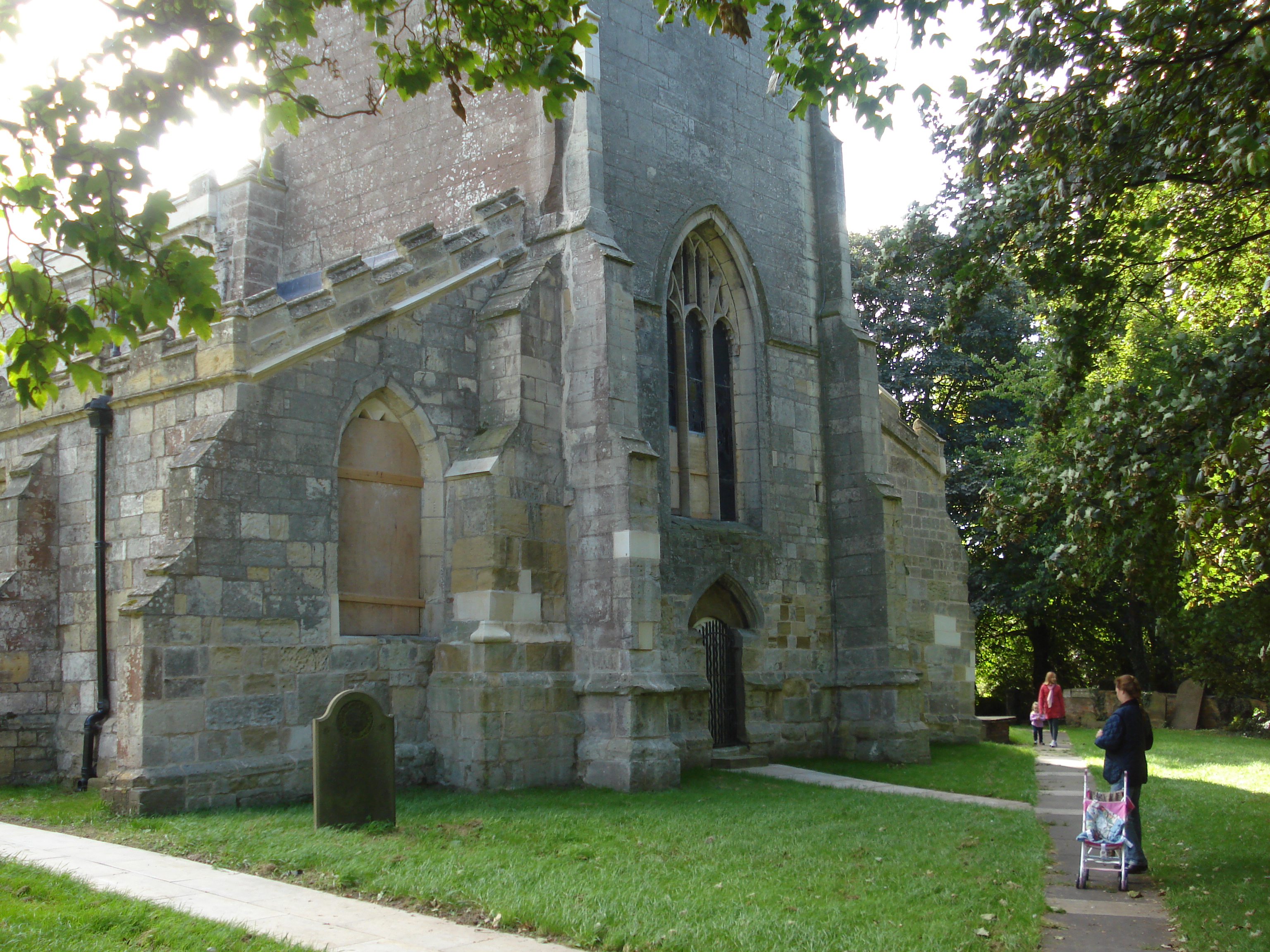
St. Andrews Church in Epworth

St. Andrews Church in Epworth

Saint Andrews Church, or at least the building, has seen better days.  It appears that worship services are still held there, but the structure itself is in need of repair.  At any rate, it is a beautiful church building with much history.  There are several memorials and graves which bear dates from many centuries ago but the most prominent on my pilgrimage is that of Samuel Wesley who died April 25, 1735.

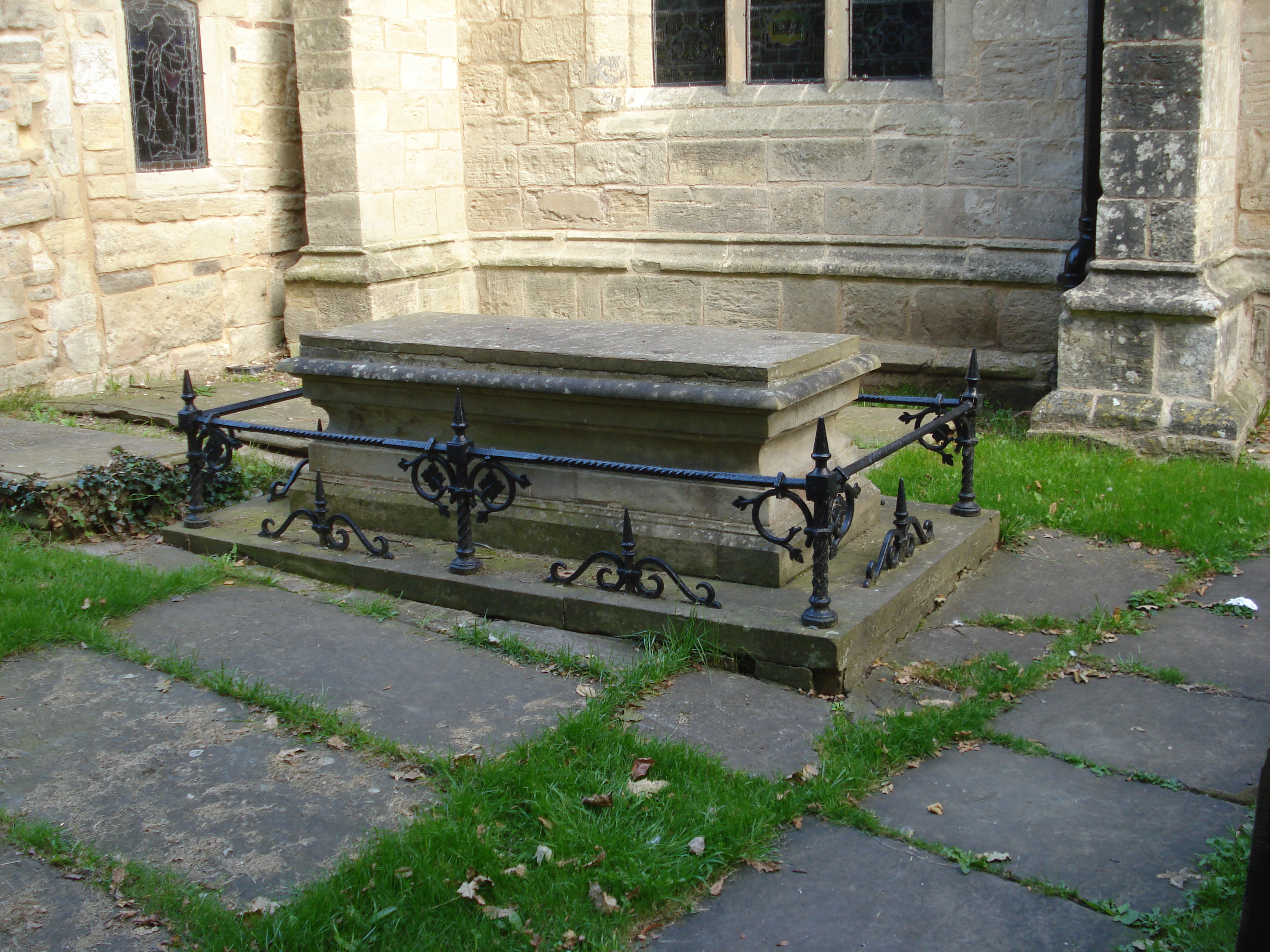
Samuel Wesley's grave

The grave of Samuel Wesley

“Here Lieth all that was Mortal of Samuel Wesley, AM. He was Rector of Epworth 39 Years and departed this Life 25 of April 1735, Aged 72. + As he liv’d so he died in the true Catholic Faith of the Holy trinity in unity and that Jesus Christ is God incarnate and the only Saviour of mankind. Acts 4-12. + Blessed are the dead which are in the Lord yea saith the Spirit that they may rest from their labours and their works do follow them.  Rev 14-13”

St. Andrews Church Baptism Font

Baptismal font from which John & Charles Wesley were baptized

The inside of St. Andrews is your basic church building from the period, though of interest to this travelogue is the baptismal font from which John and Charles Wesley likely received their infant baptism, at least that is what the sign says, they and other members of the Wesley family.  There is no reason to doubt it, all the evidence seems to point to its authenticity.

.

Epworth Market Square

Foundation of cross in Epworth’s Market Square where John Wesley preached from on several occasions

In the Market Square of Epworth is the foundation of the cross where John Wesley preached beside later in life. The cross, however, no longer remains. The plaque on the base reads:  “John Wesley (1703-1791) Preached from these steps on many occasions.” In the background, the white building on the right is The Red Lion which has a footnote in the life of the Wesley’s, though at this writing I can’t recall what it is (!).

Wesley Chapel

Wesley Chapel in City Road, London

Going on to London, there is much to see relating to the Wesley’s. The Wesley Chapel (as it later became known) in City Road, was established by John and Charles after they grew out of the Foundry Chapel. It opened on November 1, 1778 as the first Methodist chapel built in London. The chapel is still in use today and there have been many renovations, but the main structure, beams, galleries communion rails and table are all from Wesley’s time.

John Wesley's House

John Wesley’s House by Wesley Chapel

Beside the chapel is John Wesley’s home which is restored to how it was in Wesley’s time and houses much of his furniture and library. If you could walk around to the right of this picture you would notice that the windows have no windows but are bricked up.  It was explained to us that taxes on new construction were paid based on the number of windows, so they just didn’t install most of them to save money!

John Wesley's Grave

Behind Wesley Chapel is buried John Wesley, Adam Clarke and other Methodist ministers

Behind Wesley Chapel (which you’ll notice the city is encroaching on) is buried John, his sister, several Methodist ministers and Adam Clarke, Methodist minister and theologian. It looks like Adam Clarke’s gravestone had a lot to say about him, but it is all wore down and unreadable now. Clarke’s grave is flat on the ground to the right of the large marker which memorializes John Wesley, his sister Martha Hall and the Methodist ministers Duncan Wright, John Richardson, John Murlin, Walter Griffith (President of the Conference, 1813) and Thomas Olivers (“Corrector of the press of Mr. Wesley, Author of the hymn “The God of Abraham Praise” and the tune called “Helmsley.”

Inside Wesley Chapel and Wesley’s House there was much to see, below are a few pictures which need little explanation.  Click on them for a larger view:

Wesley's Library

What remains (or what has been recovered) of John Wesley’s library

Wesley's preaching tabs

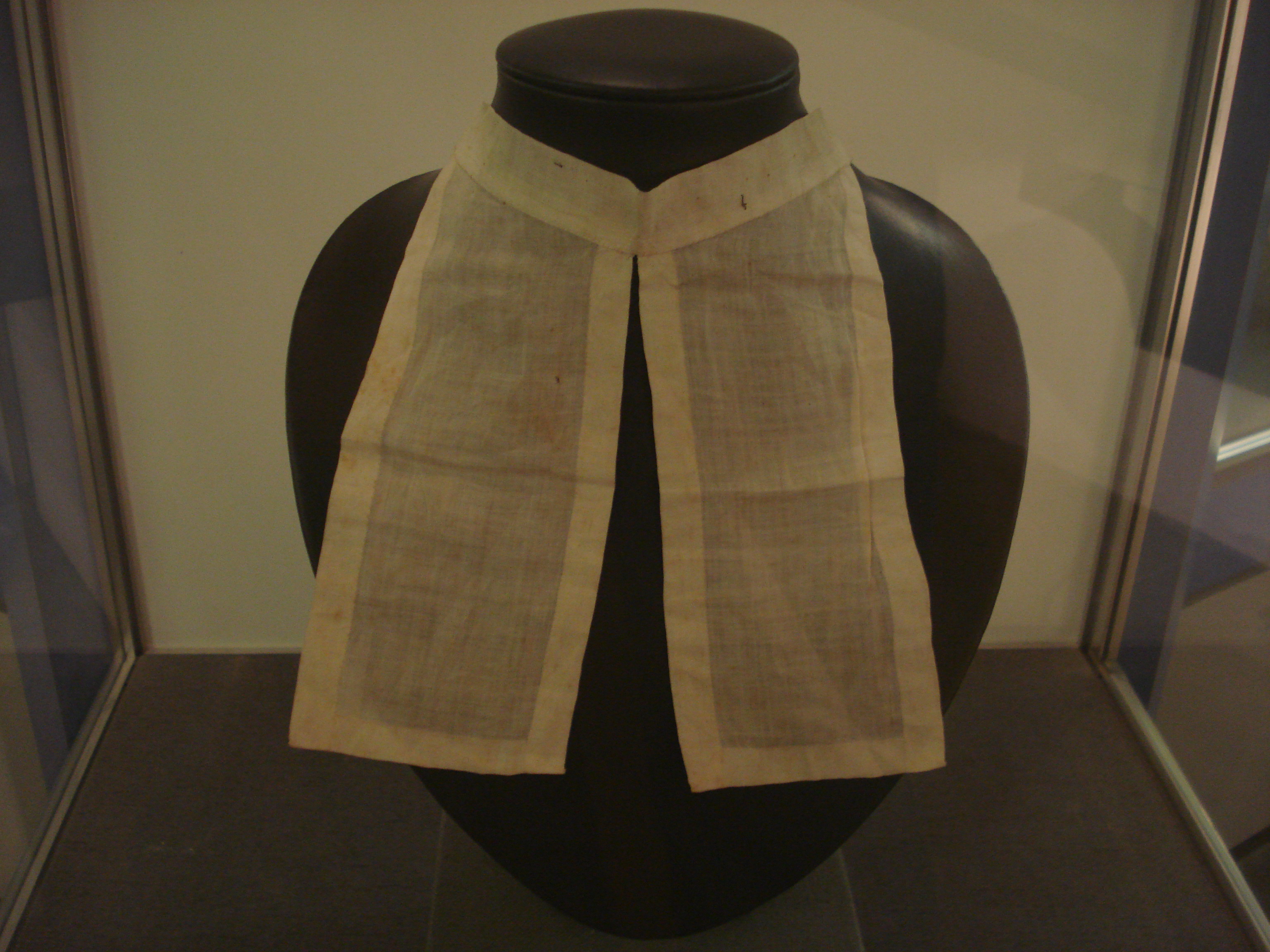
Charles Wesley’s Clerical Collar

John Wesley's Death Mask

John Wesley’s Death Mask


.

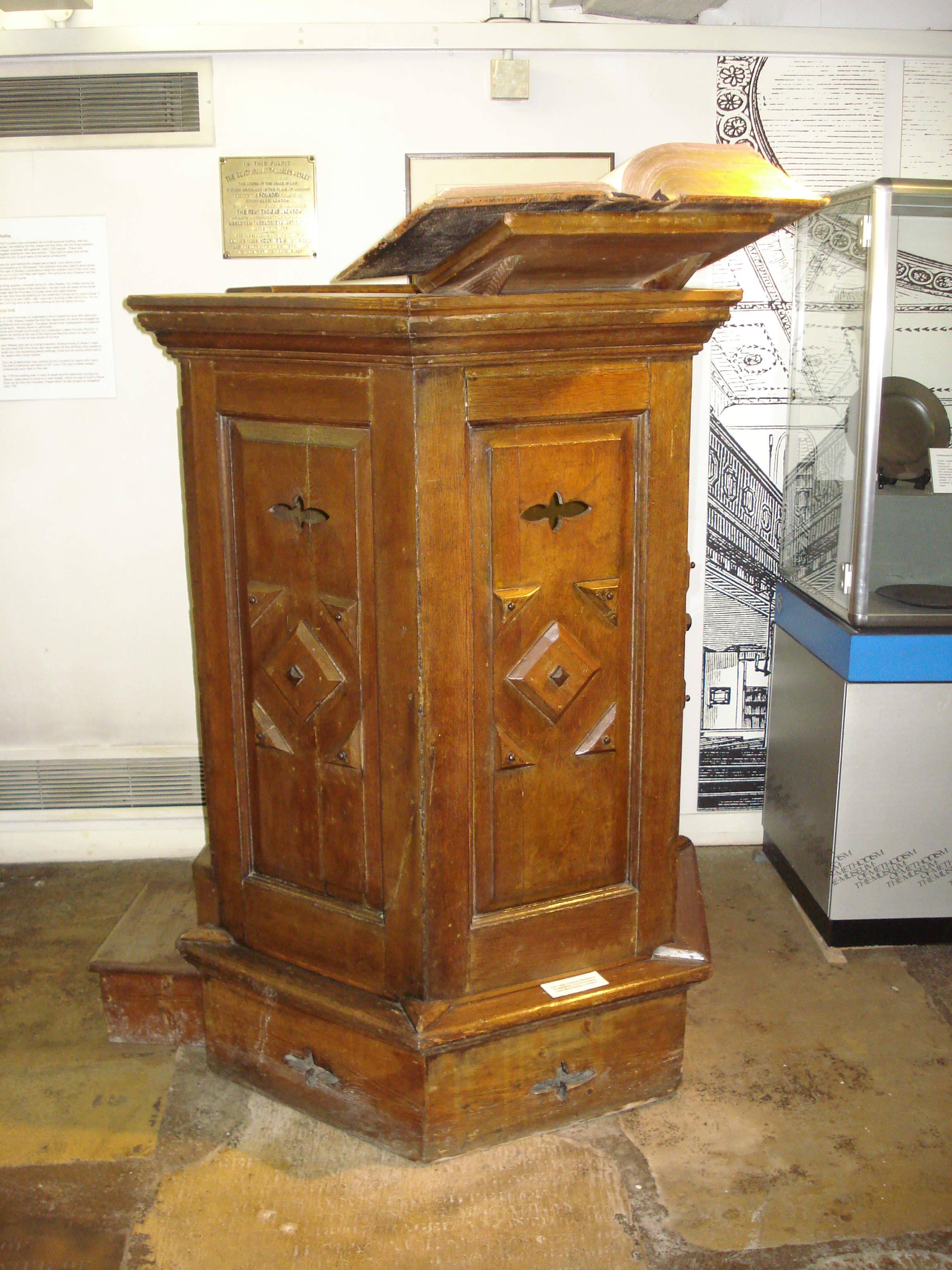
Foundry Pulpit

John & Charles Wesley’s pulpit from the Foundry Chapel

John Wesley's Desk

John Wesley’s Desk


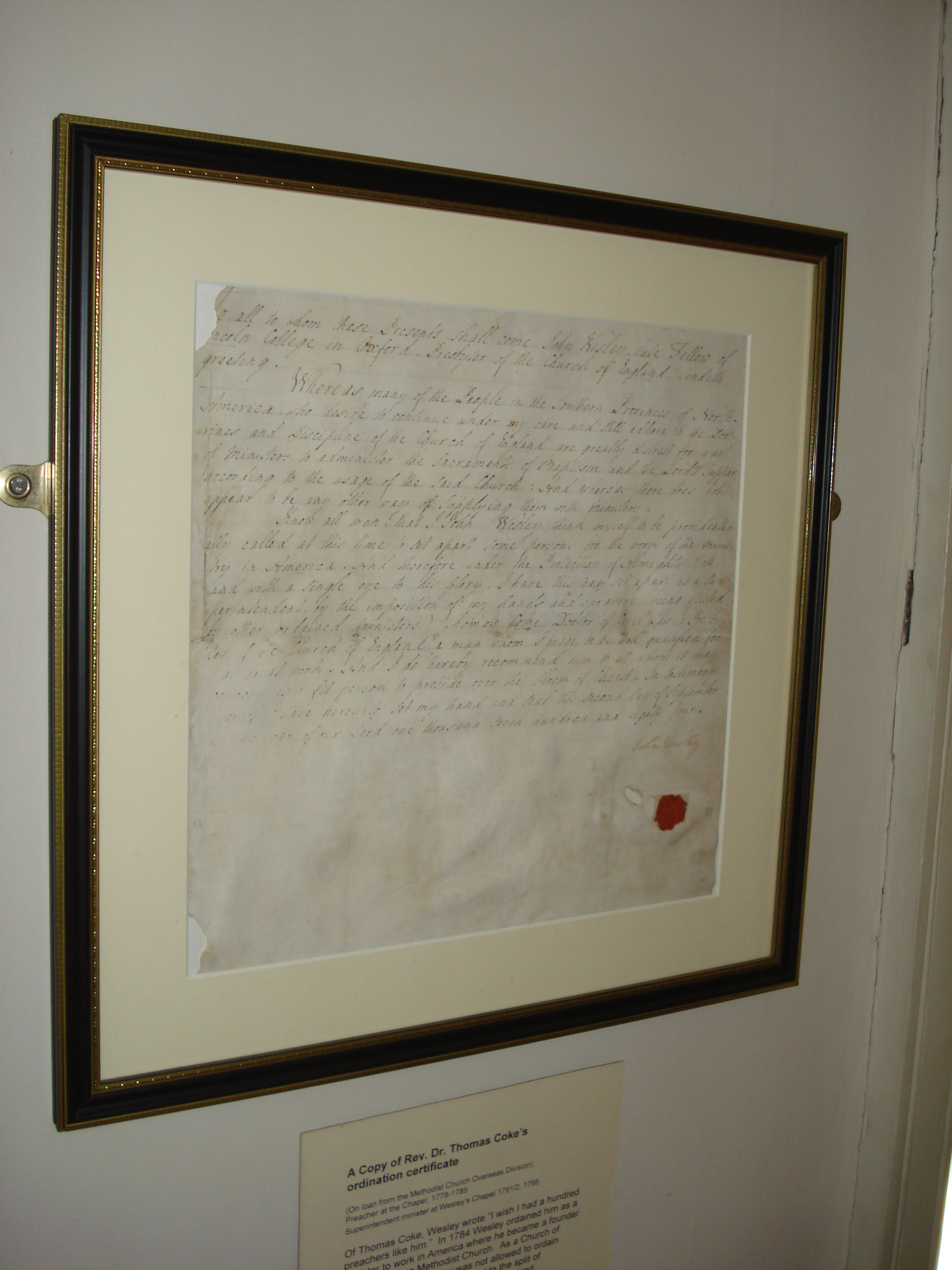
Coke's Ordination Certificate

Thomas Coke’s Ordination Certificate signed by John Wesley


Finally, a painting by Alfred Hunt in the Wesley Chapel museum of John Wesley preaching from his father’s tomb.  I’m not sure if he actually stood on his father’s grave to preach or not, but from the painting you can see what the scene was like compared to the picture of the grave today.

Wesley preaching from father's tomb

“John Wesley Preaching From His Father’s Tomb” by Alfred Hunt (1830-1896)

Samuel Wesley's Grave

Samuel Wesley’s Grave at St. Andrews Church, Epworth

A post of this size certainly couldn’t cover all of the details or include many of the pictures of a trip like this, but I hope you’ve enjoyed these few views and the spotty information about our John Wesley “pilgrimage.” It’s a trip that I would highly recommend for any who are theological descendants of Wesley or who have been impacted by the world-wide holiness revivals he and his followers have been a part of spreading.   .

.

.

.

.

.

Leave a comment

The Densford Family Sings … Christmas

Every good parent is proud of their children.  I am no exception.  At the risk of resembling one of those guys who bores his house guests with home movies, I want to share some of the Christmas performances by my children over the years. A couple of them are new while some you may have seen before, and the quality certainly isn’t professional, but . . .

With this post, I hope that you may be reminded of the joy of Christmas and even more, the Christ of Christmas!

This first one is from a past Sunday evening at the teen Christmas program.  Our youngest, Heidi, sings Away in a Manger with Holly:

This next one is from the school Christmas program at Tabernacle Christian Academy where Heidi and Julia attend a few years ago.  Heidi had the solo part in the class song, My Gift is Me:

Now I need to go back a few years, back to 1992, for these next three.  The first one is Hannah singing Away in a Manger (a popular Christmas carol!):

Again from 1992, here’s Jacob singing We Three Kings, though Hannah wants to join in!:

Jacob and Hannah try to team up in this last one from 1992, singing We Wish You a Merry Christmas:

Finally, this next one took no talent at all, but is very funny. All five of our kids are included in this Elf Yourself video (from Elf Yourself, if you’d like to try it):

.

.

.

.

.

.

2 Comments

Nelson Mandela: Saint or Sinner?

nelson_mandela

Nelson Mandela

I try not to get involved in personal attacks regardless of how wrong I might consider someone’s views to be. This post will not stray from that attempt, but I want to briefly address the fact that I continue to see posts and comments all over the Internet about Nelson Mandela that run the spectrum from nearly nominating him for sainthood to condemning him to Hell.

I’ve seen posts condemning Mandela for his association with Communist leaders, though it seems that a head of state would try to follow the adage to “keep your friends close and your enemies closer.” Even more so, being on “good” terms with world leaders (whether we agree with them or not) is far better than being on “bad” terms.

Many have condemned him for being a Communist himself. Political views aside, as well as the debate as to whether Communism is more of an economic philosophy than a political one, is this alone sufficient to discount all of the good that a person has accomplished?

Certainly, a person is often known by the company he keeps and especially in politics, one’s record is not only public knowledge but is used either in support of, or against the offender.  And sure, there may be many areas of belief and policy that we can find to disagree with but what I find very disturbing is that so many people weigh in on the character of Nelson Mandela who have neither met him nor have lived in his country and seemed to have only grabbed a sound bite or headline to form their opinon. One video making its way around the Internet, for example, went on about how “wrong” Mandela was on many of the things he said and did, but

Nico Horn … a professor in Constitutional Law in Namibia, with three earned doctorates … watched the video … and his comment was: ‘Peter Hammond lieg openlik oor Mandela se verhoor op You Tube. Het die baweek die verhoorrekord gelees en met Hammond se weergawe vergelyk. Hammond oortre skaamteloos die negende gebod. Soldaat of geestelie leier?’ Translation: ‘Peter Hammond is, well, how shall I put this gently, well, he’s mistreating the truth.’ Nico just read the court records that Hammond is referring to and his judgment? ‘The man is shamelessly mishandling the ninth commandment!’1

When I look for reliable and believable information I want to get as close to the source as possible. Books, articles and blog posts are great for fomenting the masses but to get the bottom line on Nelson Mandela, I would rather listen to someone who has lived in South Africa, who has experienced life during and after Apartheid. I have such a source in Johan Mostert. While I was attending the Assemblies of God Theological Seminary  he was one of my  professors (who I now call “friend”) and was part of the Church in South Africa during Apartheid. Tears will come to his eyes as he describes his role in propping up discrimination in the Church as they seemed to lose sight of what Scripture teaches on the value of all of humankind regardless of color. Now convinced of where the Church went wrong in those days, he has responded to some of the criticism leveled at Nelson Mandela which is very enlightening; so with his permission, I want to share it with you here.

I don’t expect that you will agree with everything he says, but at least you can hear it from a man who lived under Apartheid and has emerged repentant and a better man through Mandela’s influence:

Johan Mostert

Johan Mostert

I have a need to respond to the Mandela pessimists who are appearing on FB. Some of my friends have people who are reacting against all the honour being paid to Mandela. Some have resorted to derogatorily labeling him a Communist and a Marxist, and other dear brothers and sisters have questioned his eternal salvation. Many in South Africa are disillusioned that the present state of affairs does not reflect the optimism and dreams that Madiba had for our nation. Allow me just a few comments:

1. Putting a label on someone in the hope that the label will destroy their reputation is a very poor argument. To argue that Mandela is bad because he received financial and strategic support from Gadhafi, Castro, Russia and China would require you to come to the conclusion that apartheid was good because it received financial and strategic support from the West, the CIA and the Mossad.

2. The fact that the pariah’s of the world sided with the ANC fight for human rights and the Evangelical Christians sided with (and tacitly supported) apartheid is a serious stain on our Christian witness.

3. Marxism was correct when it pointed out that the rich were exploiting the poor. But Mandela was wise enough to see that although Marxism had the right diagnosis, it had a poor economic prescription. The so-called Communist utopia is a figment of the imagination; it is in total disrepute as an economic system today. Today South Africa is a thriving, though still seriously polarized, Western economy. It is poised to potentially usher in vast economic development to the rest of Africa.

4. Nothing of today’s economic hardships, or violence, or corruption in South Africa can begin to compare with the situation under apartheid. We came out of an era of massive human rights violations, brutal interrogations, detention without trial, minority imposition of discrimination on the majority, and arrogant racism. Our so-called “Christian Nation” was a myopic myth! We only read the Bible verses that we liked and ignored the 2000+ verses where it spoke about our responsibility to the poor!

5. The Kingdom wisdom to respond to your enemy with Truth and Reconciliation was beyond human brilliance! The alternative, to go for a War Crimes-type criminal court that ends up with the public execution of those guilty of crimes against humanity, would have torn our nation apart! I’m not suggesting that we did it all perfectly well, but given the alternative, thank God for the brilliant guidance of Archbishop Desmond Tutu (“No future without forgiveness”)!!

6. Ivory tower musings over how God would judge all of Mandela’s “good works”, and suggesting that they are all but “filthy rags” that won’t earn him a place in heaven is disturbingly interesting. It fascinates me that Christians who KNOW the law of God (“judge NOT, so that you won’t be judged” Matthew 7:1) would demean themselves to sit as judges of another’s salvation and criticize the sinner Mandela who is not supposed to know the law of God, but who, instinctively DOES the law of God (Romans 2:14). How does that work?

Mandela was not a saint. He had his flaws and he made many mistakes. A friend who was a missionary to Turkey for many years, posted on my FB: “Mandela had the power in his hands to declare Africa for Africans and turn South Africa into a killing field. He chose to build a nation, rather than tear one apart. He stands head and shoulders above John Kennedy, Mother Theresa, Gandhi, and any other politician, philosopher or leader I can remember in my brief 71 years. He was unique.” All I can say, Doug, is “amen”.2

I’m not going to make a final judgment on Nelson Mandela. I do choose however, to remember him for his willingness to forgive those who imprisoned him and his determination to bring healing and reconciliation to a nation that suffered under Apartheid for so long. May we all strive for so great a goal.

.

.

1 Facebook post by Johan Mostert, 9 December 2013. Used with permission.

2 Ibid.

5 Comments

A Remarkable Life: Karl W. Scheufler-Minister, Missionary and Chaplain

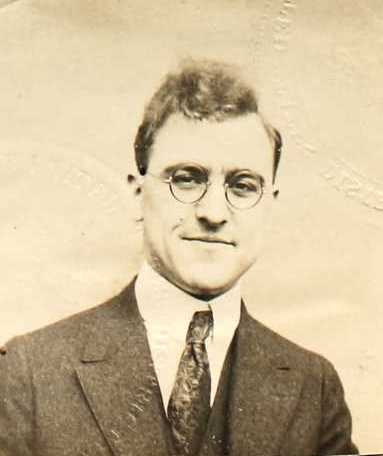
Karl Scheufler

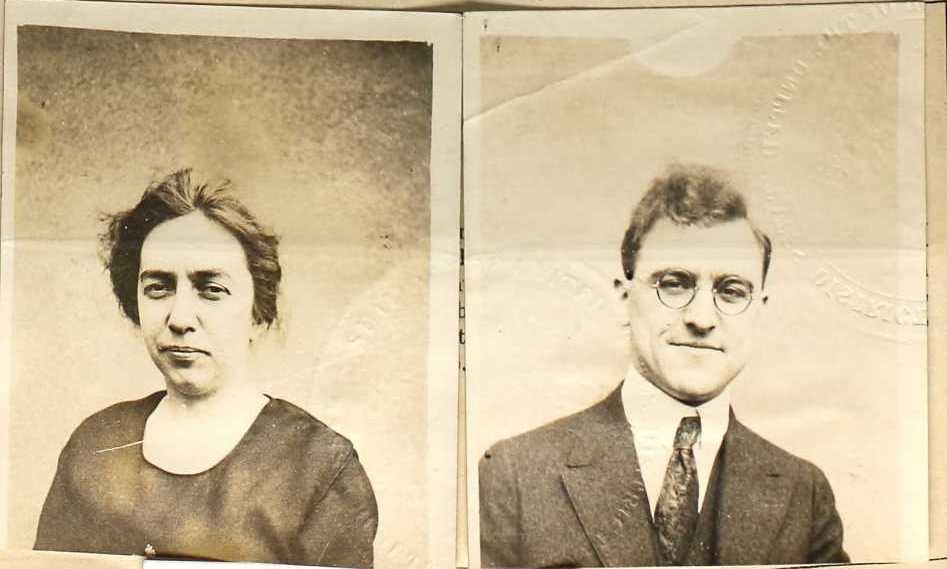
Karl Scheufler’s passport photo taken in 1921

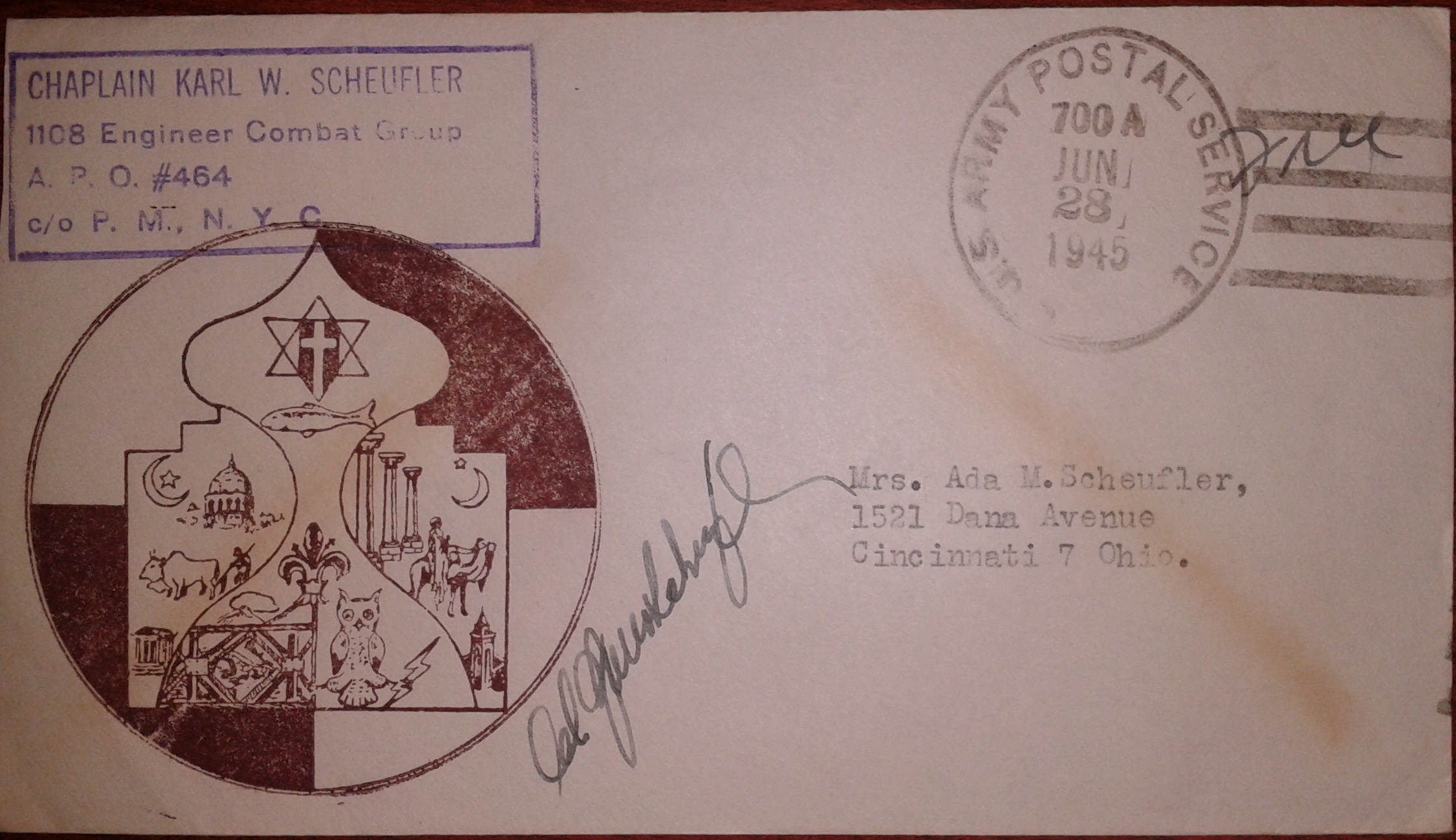
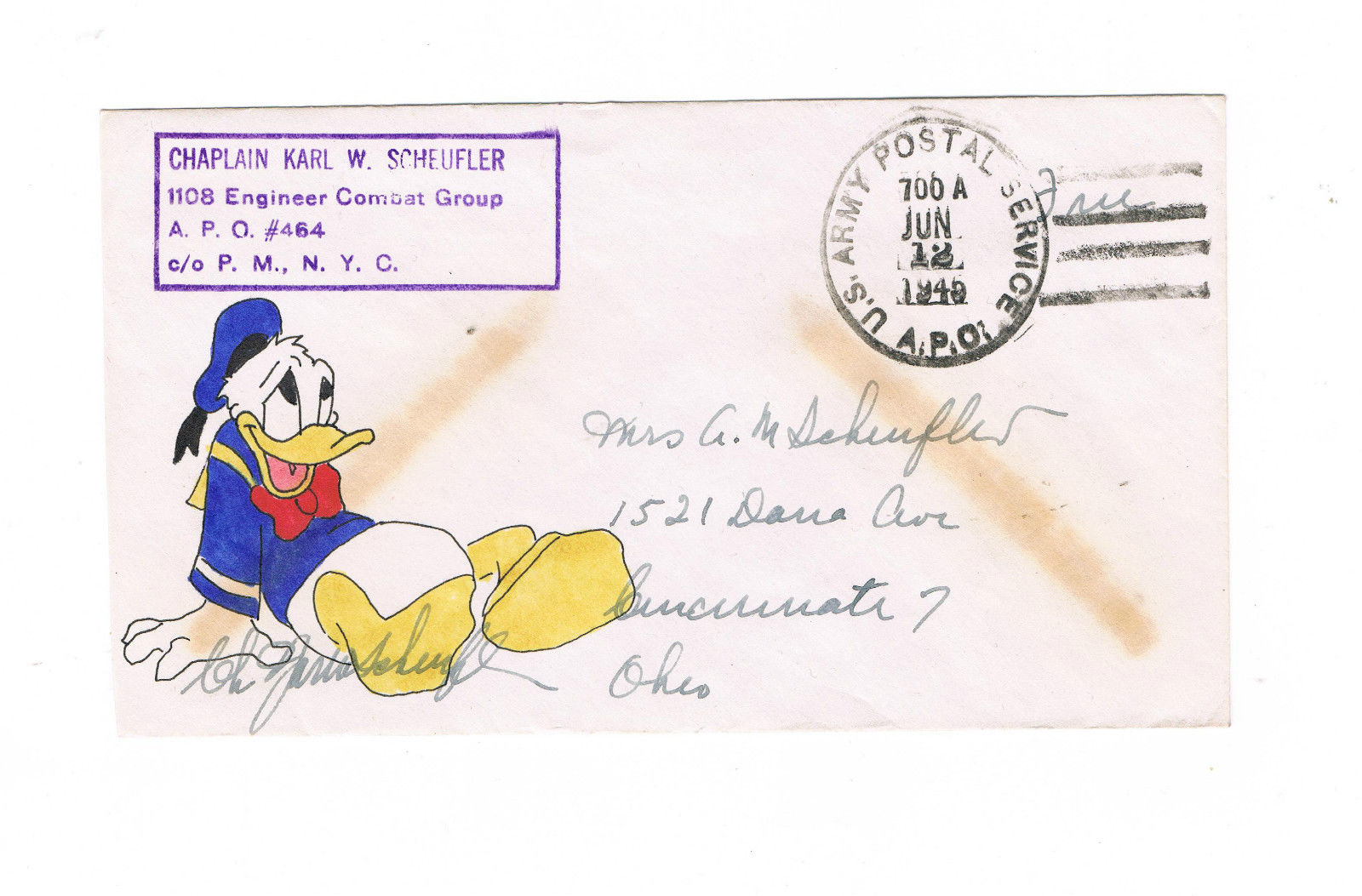
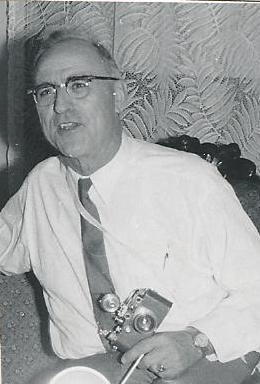
Occasionally, I come across people who really impress me.  Sometimes these are living people, many times they have died long ago. I usually become acquainted with these “dead” people through something of theirs that I have found or purchased.  This is the case with Karl William Scheufler. I bought a few postal covers (decorated envelopes) that he had sent to his wife and son during World War Two from Europe.

A few characteristics of these covers caught my eye causing me to buy them: First, they were from an Army chaplain, which always interests  me  since  I  am also  one. Second,

Karl Scheufler Cachet

Cachet designed and drawn by Karl Scheufler

they were mailed during wartime from the combat zone, two of them in April 1945 just before the end of the war in Europe and one in June, just after. Third, there is an interesting cachet on the envelopes (which he later highlighted in a history book he wrote, below). Fourth, they were addressed to his family in Cincinnati, where I am from.

It would be great if I was related to Karl (I hope he doesn’t mind me calling him by his first name!) but I’m not. However, as I researched his life a bit after receiving these envelopes, I discovered that he is a man who I wish I could claim as an ancestor, or at least as a friend.  Let me tell you a little about him:

Karl was born 6 February 1898 in Sandusky, Ohio to Fred and Amelia Scheufler. He had one sister, Anna, who he put on his World War Two Draft Registration Card as the person who would always know his address. By 1910 he had moved with his family to Toledo, Ohio (1504 Western Avenue) and graduated from Morrison R. Waite High School in 1916. He still showed his “home of record” in Toledo when he was enlisted in the Army in some form two years later.  His enlistment record shows him enlisting in Delaware, Ohio on 5 October 1918 and states,

Students Army Training Corps, Ohio Wesleyan University, Delaware Ohio, to discharge Private honorable discharge, 19 Dec 18.

I’m not certain what this means, whether it is that he spent time in the enlisted Army, or whether this was part of the procedure for being part of what is now ROTC at colleges and universities. Whatever it meant, he later showed “1918” as his original “enlisted in the Army” date when he was serving in World War 2.

Karl’s education was extensive.  According to the Yale University Divinity School Library, “Karl attended Ohio Wesleyan University, Columbia University, Union Theological Seminary (NY), Harvard, and Boston University, receiving the A.B., A.M., and S.T.B. degrees.”

Karl & Ada Scheufler

Karl and Ada’s passport photos taken in 1921 just before they left for China

On 23 June 1920, Karl and Ada were married then in 1921, Karl was ordained an elder in the Methodist Church and he and Ada applied for passports to embark on missionary work in China for the Board of Foreign Missions of the Methodist Episcopal Church. His passport was approved and issued on 3 June 1921 and they set sail for China on the S.S. Nile on 17 August 1921. The 1921-22 school year found Karl and Ada at the University of Nanking (China) in the Nanking Language School of the Department of Missionary Training. From there they went to Yenping, Fukien Province as missionaries until 1926. Karl kept meticulous records of not only their own missionary work, but also the interaction of the mission agency as well as what was going on around them in China. The Karl and Ada Scheufler Papers are now in the archives of Yale University Divinity School Library serving as a source of history for this period in China. A combination of the political unrest in China in 1926 and a shortfall in missions funding prevented the Scheuflers from remaining in China after 1926.

Scheufler family

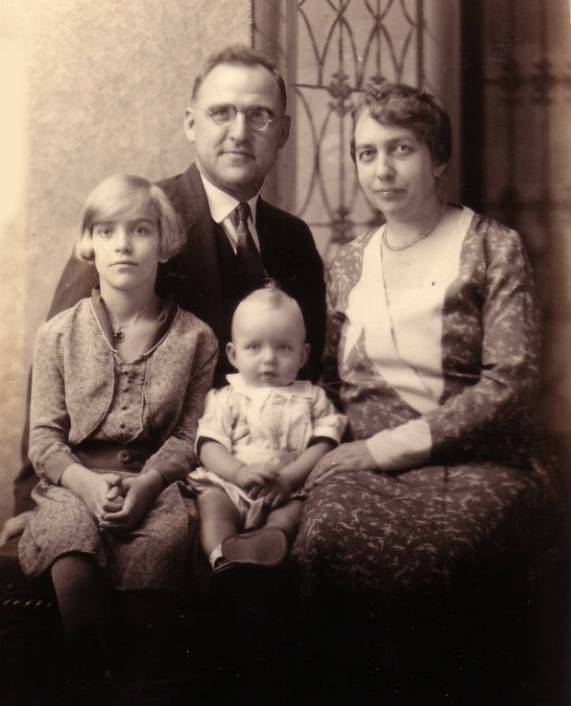
Karl Scheufler, wife Ada, son Lowell and oldest daughter Jean. 1930s

In the 1930s and 1940s until he returned to the Army as a chaplain, Karl was the pastor of Trinity Methodist Church in Cincinnati Ohio and the Scheuflers lived on Auburn Avenue. The 1940 federal census shows that he made $2800 a year in this position. Karl and Ada had two daughters and a son. One of the daughters, Elaine, was born in 1934 the other’s name was Jean. Their son, Lowell, was born in 1931. Lowell went on to follow in many of his father’s footsteps. He began ministering in the United Methodist Church in 1963, serving churches in Columbus and Cincinnati. Lowell also taught for 15 years at United Theological Seminary (Dayton, OH) and the Methodist Theological School of Ohio (Delaware, OH).

Another cachet Karl drew.

Another cachet Karl drew.

On 19 December 1942, Karl joined the 355th AAA Searchlight Battalion as a chaplain (captain) and was with them in North Africa and Europe. During his service in World War 2, he drew many interesting cachets (like the one I came across) that fetch several dollars today. Many can still be found for sale.

.

Chaplain Scheufler in Tunisia

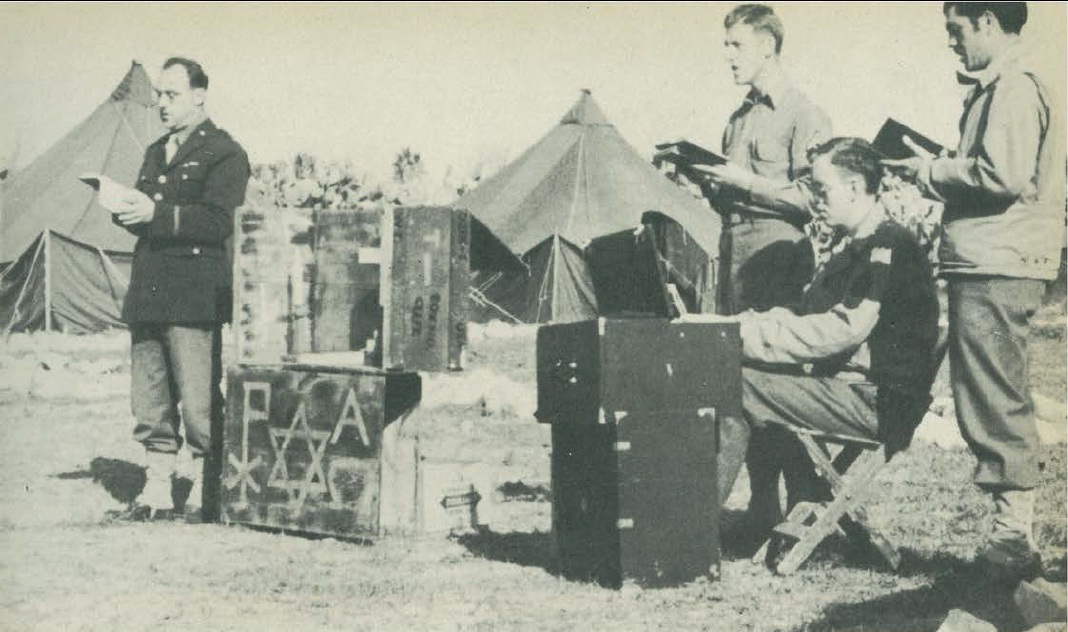
Chaplain Scheufler leading worship in Tunisia during WW2

As chaplain, Karl was very busy during the war. Not only did he provide for the religious needs of his unit by performing worship services, he provided places for Soldiers to relax and have fun. He also guided several R & R trips into Italy for the benefit of the Soldiers in his unit. Much of what he did as chaplain in the 355th is spelled out in the regimental history he wrote in 1946, “Carthaginians, Romans and Americans; Overseas with the 355th AAA SLT BN.” Some records indicate that Karl also served in the Philippine Islands. He mustered out of the Army on 30 March 1946, returning home to his family in Cincinnati, Ohio.

Karl Scheufler

Karl Scheufler later in life

A few year after the end of the war, the family moved to Columbus Ohio (946 Bryden Road) where Karl continued to pastor in the Methodist Church. Ada died in 1958, then later in life, Karl must have returned to Cincinnati to live out his final years. He died while living in a nursing home on 7 April 1989.

Only eternity will tell the number of lives that Karl Scheufler touched while on this Earth. Ministering as a local pastor, missionary to China and chaplain during wartime, his influence would have been enormous and substantial. Numerous, also, would be those inspired by his life; like me, inspired to make a mark in this world -not for fame or fortune but for the Kingdom of God, for the glory of God, for the salvation of souls. If my legacy is only a fraction of Karl Scheufler’s, I will have gone far toward this goal.

I want to end this post with Karl’s own words.  In July 1946, he concluded the Forward to the book he wrote about the history of his wartime unit with this message:

I close with the sincere prayer, that the grace of the Eternal

might be with you and with yours, eternally.

.

.

.

.

1 Comment

Is “Gay” the New “Black”?

Homosexual activists are quick to take advantage of any angle to give them an apparent edge or help them win a case in court. They have long maintained (even in the Church) that their pursuit of rights is similar to that of the civil rights movement of the 60s and the women’s rights movement of the 19th and early 20th centuries.  There are many flaws in this contention, however, as they seek this “minority” or “priviledged” status.

Voddie Baucham is the pastor of preaching at Grace Family Baptist Church in Spring, Texas, and a council member for The Gospel Coalition. He has written an excellent article confronting the homosexual agenda’s attempt to claim the status of blacks in their goal of acceptance of their lifestyle. The full article can be found at the Worldview Church website but I give you a taste of it here:

Gay Is Not the New Black

by Voddie Baucham

It’s hard to deny that homosexual marriage appears to be a foregone conclusion in America. This is a frightening prospect not only for those of us who understand marriage to be a testimony of the relationship between Christ and his bride, the church, but also for all who value the family and its contribution to the well-being of society and human thriving. And while it’s difficult to watch a coordinated, well-funded, well-connected propaganda strategy undermine thousands of years of human history, it’s especially disconcerting to witness the use of the civil rights struggle as the vehicle for the strategy.

Voddie Baucham

Voddie Baucham

The idea that same-sex “marriage” is the next leg in the civil rights race is ubiquitous. One of the clearest examples of the conflation of homosexual “marriage” and civil rights is Michael Gross’s article in The Advocate, in which he coins the now-popular phrase “Gay is the new black.”1 Gross is not alone in his conflation of the two issues, however. At a 2005 banquet, Julian Bond, former head of the NAACP, said, “Sexual disposition parallels race. I was born this way. I have no choice. I wouldn’t change it if I could. Sexuality is unchangeable.”2

Nor is this kind of thinking exclusive to the political left. When asked by GQ magazine if he thought homosexuality was a choice, Michael Steele, former chairman of the Republican National Committee, replied:

Oh, no. I don’t think I’ve ever really subscribed to that view, that you can turn it on and off like a water tap. Um, you know, I think that there’s a whole lot that goes into the makeup of an individual that, uh, you just can’t simply say, oh, like, “Tomorrow morning I’m gonna stop being gay.” It’s like saying, “Tomorrow morning I’m gonna stop being black.”3

Even the California Supreme Court bought in to this line of reasoning. In a February 2008 decision they reasoned:

Furthermore, in contrast to earlier times, our state now recognizes that an individual’s capacity to establish a loving and long-term committed relationship with another person and responsibly to care for and raise children does not depend upon the individual’s sexual orientation, and, more generally, that an individual’s sexual orientation—like a person’s race or gender—does not constitute a legitimate basis upon which to deny or withhold legal rights.4 (emphasis added)

The California Supreme Court, like Gross, would have us believe that the homosexual struggle for a redefinition of marriage puts them in the same category as my ancestors. However, they would rather you didn’t take a closer look, lest you see how flimsy the comparison turns out to be.

———-

I urge you to continue reading this article at the Worldview Church website . . . where you will also find the endnotes notated above in the quoted article.

.

.

.

Leave a comment

What We Can Learn from the MPs

As the chaplain for the Military Police Corps Regiment and the U.S. Army Mlitary Police School, I’m involved in a lot of MP events throughout the year. Many of these events happen in one week of September during the Military Police Corps Regimental Anniversary week at Fort Leonard Wood, Missouri.  This year, they celebrated 72 years as a permanent corps of the U.S. Army. I previously shared in my blog the Memorial Message which I presented at the Memorial Tribute for the fallen MP Soldiers from the past 12 months.  Today, I would like to share a brief reflection of the week with what the MPs can teach all of us in respect to our place in the larger force, our remembering the families of fallen Soldiers and our attitude toward those who have died in combat. It is a bit brief due to the space limitations of the post newspaper in which it was published, but the lessons we can learn are easily identified.

.

Military Police Set Example

Thursday, 03 October 2013
By Chap. (Maj.) Daryl Densford
Special to GUIDON

The Military Police Corps Regiment just celebrated its 72nd anniversary. The week was full of events ranging from the fun-filled Regimental Golf Tournament, the celebrative Hall of Fame Induction to the solemn Memorial Tribute. At least for MPs, it was a week to remember.

It all began with a Gold Star Family Reception where members of the command group were able to meet with the Families of the MPs who had fallen in combat over the past year. This intimate reception provided an opportunity to reach out to the Family members, offering condolences while encouraging and supporting them in this difficult time.

Chaplain-Memorial_Tribute

Speaking at the MP Memorial Tribute

At the Memorial Tribute, the next day, we honored our fallen and memorialized them with a sacred ceremony and the placing of memorial bricks in the walkway of the MP Memorial Grove. These bricks will serve as reminders of the sacrifice made by countless MP Soldiers over the years.

All through the week, we saw reminders of the excellent work done by members of the Military Police Corps around the world in both garrison and contingency operations. We remembered the various MP brigades and groups as we carried their colors in the run and prominently displayed their colors at the ceremonies and events. We remembered the individual MP Soldiers as we presented and recognized their colors.

The Military Police Corps Regiment has set a great example for all of us to follow, even in the day-to-day hustle and bustle of our busy lives. We need to remember that we are just one small part of a much larger force serving professionally in locations around the world, many in difficult situations and dangerous areas. We also must remember to continue to encourage and support the Families of those who have lost loved ones in battle. We need to be there for them, reach out to them, and pray for them.

Finally, we should honor, in our lives lived faithfully, those service members who have given their lives in our defense, remembering that the sacrifice of these Soldiers, Sailors, Airmen and Marines is what makes our freedom possible; living the admonition of St. Paul when he said, “Share in suffering as a good Soldier of Christ Jesus” (2 Timothy 2:3, ESV).

(Editor’s note: Densford is the Military Police School chaplain.)

__________

.

This article on the Guidon website can be found here.

My previous post about the MP Regimental Week Memorial Tribute can be found here.

.

.